













A few years ago, I helped a friend sort out inventory at her two-location boutique. She was buried in size 6 dresses that just wouldn’t sell, and every week she ran out of size 10s, the only size flying off the racks. Nobody told her ML would fix everything overnight, and it didn’t.
But once she started using a simple demand-forecasting tool built on machine learning, her stockouts dropped by a third within two seasons.
That’s the real story of machine learning in the retail industry: not robots running the store, but software that notices patterns humans are too busy (or too tired) to catch.
Machine learning in the retail industry means using algorithms that learn from past sales, weather, promotions, and even foot traffic to predict what happens next and then acting on that prediction before a human would’ve spotted it. This guide breaks down where it actually earns its keep, where it falls flat, and how to start without blowing your budget on a system built for a company ten times your size.
Table of Contents
What Machine Learning Actually Does in a Retail Business
Strip away the jargon and machine learning is pattern recognition at scale. Feed it years of sales data, and it finds the relationships a spreadsheet never could, like how a heatwave in June bumps rotisserie chicken sales by 22%, or how a specific email subject line drives return visits three days later.
It’s not magic, and it’s not one thing. In retail, it shows up as several distinct tools wearing the same coat:
- Forecasting models that predict what you’ll sell, by SKU, by store, by week
- Recommendation engines that decide what to show a shopper next
- Pricing models that adjust prices based on demand and competitor moves
- Computer vision systems that watch shelves, checkouts, and loss points
- Chat and support models that handle routine customer questions
Every one of these gets lumped under “AI” in marketing copy. But the mechanics and the payoff are different enough that treating them as one thing is where a lot of retailers waste money.
Demand Forecasting: The Anchor Use Case for Machine Learning in the Retail Industry
If you only adopt one application, make it this one. Demand forecasting is where machine learning in the retail industry has the clearest, most measurable payoff, because the problem it solves guessing future demand is one every retailer already has, whether they admit it or not.
Traditional forecasting leans on moving averages and gut feel from whoever’s been at the company the longest. That works fine until it doesn’t: a new competitor opens nearby, a TikTok trend spikes demand for a product you stocked lightly, or a supplier delay throws off your usual pattern.
Machine learning handles stuff like this way better because it’s not stuck looking at last year’s numbers. These models weigh all sorts of live signals at once price changes, sales, local events, promos, even social buzz. And they keep updating as new data comes in instead of waiting for a sleepy quarterly meeting to rerun the numbers.
Industry research backs this up: retailers using machine learning for demand planning see their forecasts get sharper, their stockouts drop, and their overstock headaches shrink. That’s because the models react almost instantly to what’s actually happening, not just what happened last season.
What does this look like on the ground? Instead of your old “We’ll sell 400 units next month” guess, you get a range, a confidence score, and a breakdown by each store or sales channel. Suddenly, you can plan with much less guesswork. That’s the difference between guessing and planning.
Inventory Optimization and the ROI Math
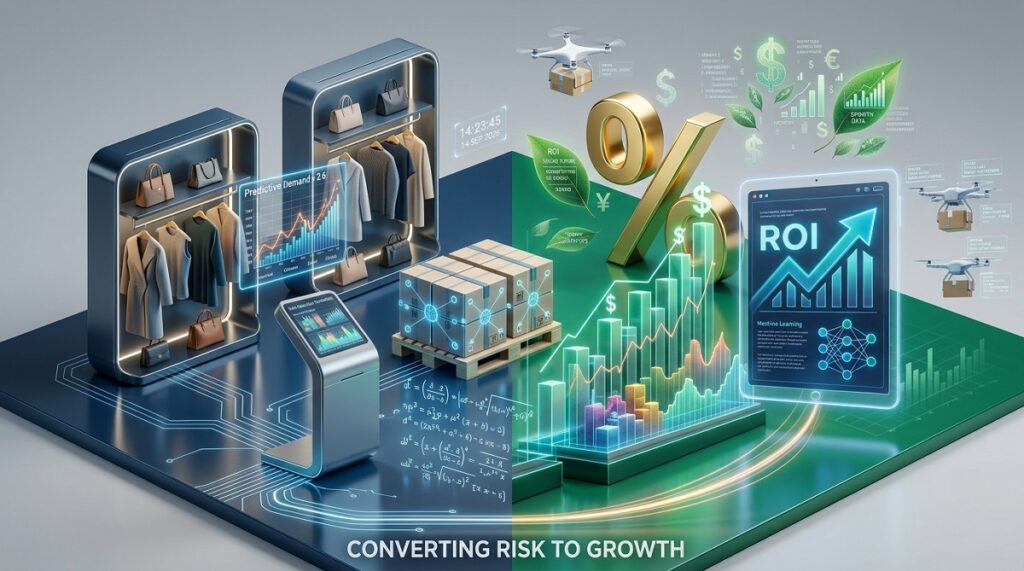
Here’s where I’ll be blunt: inventory is where the money actually shows up. Forecasting is only the first step. The real results show up in your P&L, because inventory optimization follows.
Too much inventory just locks up your cash, costs you money to store and insure, and means more markdowns later. Too little? You lose sales and usually lose those customers for good.
Machine learning attacks both sides at once by recommending reorder points and safety stock levels per SKU per location, instead of applying one blanket rule across your whole catalog.
A mid-sized battery and energy systems retailer that rolled out ML-based forecasting and replenishment cut stockouts by 25% while trimming excess inventory by 12%, and saw inventory ROI improve by 18% all inside six months.
That’s not an outlier headline number; it’s a realistic range for what a properly implemented system delivers when the underlying data is clean.
The ROI math generally breaks down into three buckets:
- Reduced carrying costs from holding less dead stock
- Fewer stockouts, which directly protects revenue you’d otherwise lose to competitors
- Lower markdown losses because you’re not scrambling to clear excess inventory at a discount
None of that shows up instantly. The change doesn’t happen overnight, either. Most retailers see results after a couple of inventory cycles. If some vendor promises instant miracles, they’re selling a dream, not smart forecasting.
Personalization and Recommendations
This is the application shoppers actually notice. And you know those “Customers who bought this also bought…” messages? That’s not just a marketing trick; real recommendation models power those, using your purchase history, what you browsed, and sometimes even how long you stared at a page.
When done right, personalization nudges up your average order value without annoying shoppers. When done wrong, it shoves the same three “bestsellers” at everyone and just makes people feel watched instead of helped.
The difference? It usually comes down to how much actual customer data the retailer can use and how often they bother to retrain the model.
Dynamic Pricing
Airlines figured out dynamic pricing ages ago; retail’s been playing catch-up. Now, pricing models update based on demand, inventory, competitor prices, and sometimes even the time of day.
Supermarkets mark down food before it spoils. Online shops automatically keep prices competitive; no one needs to sit there refreshing the competition’s website.
The risk here is real, and I won’t gloss over it: customers notice when prices swing too fast, and it can feel exploitative if it’s not handled with some guardrails.
Most retailers that do this well cap how often and how far prices move, rather than letting the algorithm run unchecked.
Loss Prevention and Computer Vision
Shrinkage shoplifting, breakage, clerical screw-ups chews away at profit quietly. Computer vision systems can now watch the shelves and the checkout lanes and spot weird stuff: items scanned wrong, missing from a cart, or just not adding up.
This isn’t about surveillance for its own sake. Retailers using it well treat the flags as a starting point for a human to review, not an automatic accusation. The technology catches patterns; people still make the calls.
Where It Goes Wrong
Most articles on this topic skip straight to the wins. That’s not honest, and it’s not useful if you’re the one signing off on the budget.
Bad data breaks everything. If your point-of-sale system has been miscategorizing products for two years, the model learns those mistakes and repeats them with confidence. Garbage in, garbage out isn’t a cliché here; it’s the single biggest reason ML rollouts underperform.
Small retailers often buy tools sized for chains with 500 stores. A forecasting platform built for enterprise-scale data needs volume to find real patterns. Feed it a single store’s worth of transactions and it’ll either overfit to noise or need months to become useful.
And teams sometimes trust the model too much, too fast. A forecast is a probability, not a promise. The retailers who get the most value treat ML output as a strong recommendation that a human still reviews, especially in the first year while everyone’s learning where the model tends to be wrong.
How to Actually Get Started
You don’t need a data science team to begin. Here’s a realistic path:
- Start with one problem — usually stockouts or excess inventory on your top 20% of SKUs
- Audit your data before you buy anything; clean sales history matters more than the software
- Pilot on a subset of stores or products before rolling out chain-wide
- Set a baseline — know your current stockout rate and carrying costs so you can actually measure improvement
- Keep a human reviewing forecasts for the first two to three cycles
The good news? Smaller retailers aren’t locked out. Loads of platforms now fit modest budgets, not just giant chains. The technology’s gotten cheaper, and the bar to entry is way lower than most people think.
The Bottom Line
And honestly, machine learning in retail isn’t about robots replacing gut instinct. It just lets folks running inventory, pricing, and merchandising see things no spreadsheet could catch trends and blips you’d miss in the chaos.
The real winners aren’t the ones chasing flashy headlines about AI. They’re the shops that started small, fixed their data, and kept humans involved while the model proved itself.
So, if your storage room’s jammed with sizes no one wants, or your bestsellers keep vanishing off the shelves, don’t blame your staff. That’s a forecasting problem exactly the kind machine learning was built for.
Start with your top-selling SKUs, get a baseline on your current stockout rate, and pilot a forecasting tool on a handful of stores before you commit chain-wide.
Six months from now, you’ll either have the receipts to prove it worked or the data to know it’s not the right fit; either way, you’ll know more than you do today.