












MIT Technology Review’s 10 breakthrough innovations-and what they mean for you! Every January, a small team of editors and writers over at MIT Technology Review gathers together to answer one of the hardest questions in tech journalism: “What will actually matter, not in six months, but twenty years from now?”
And every year, millions of readers, investors, scientists, and tech junkies like you and me wait eagerly to find out.
The problem is that, typically, the articles explaining breakthrough technologies only give you a quick overview, buried under a bunch of confusing technical jargon, or even just pasted as a list.
By the time you get to read them, you’re still sitting with 10 bullet points but no idea how they’re going to affect your life, your career, or the world you’re going to be living in.
So, in this article, we’re going to break down all 10 breakthrough technologies on MIT’s TR10 list, including what they are, why they really matter and what’s so exciting (and also complicated) about each one.
Let’s get right to it.
Table of Contents
What is MIT Technology Review, and Why Should I Even Care?
Before diving into the list of technologies, I want to quickly give you some context because it is not everybody’s everyday thing to read MIT Technology Review, and that is okay.
- It was first established in 1899 and back in 1899! The Massachusetts Institute of Technology has become one of the most respected institutions of science and technology in the world, but beyond its heritage, what makes it truly special is the annual TR10 list.
- This list highlights ten technologies every year since 2001 that they believe are going to be revolutionising our world, not tomorrow, but the decades from now.
- MIT has correctly called breakthrough technologies like natural-language processing in 2001, wireless power in 2008, and even reusable rockets in 2016. That is why the MIT TR10 list really does warrant your attention.
- It’s not only about new inventions but about those that have reached a critical point, shifting from an idea in a laboratory to something poised to change absolutely everything. That is precisely the filter applied.
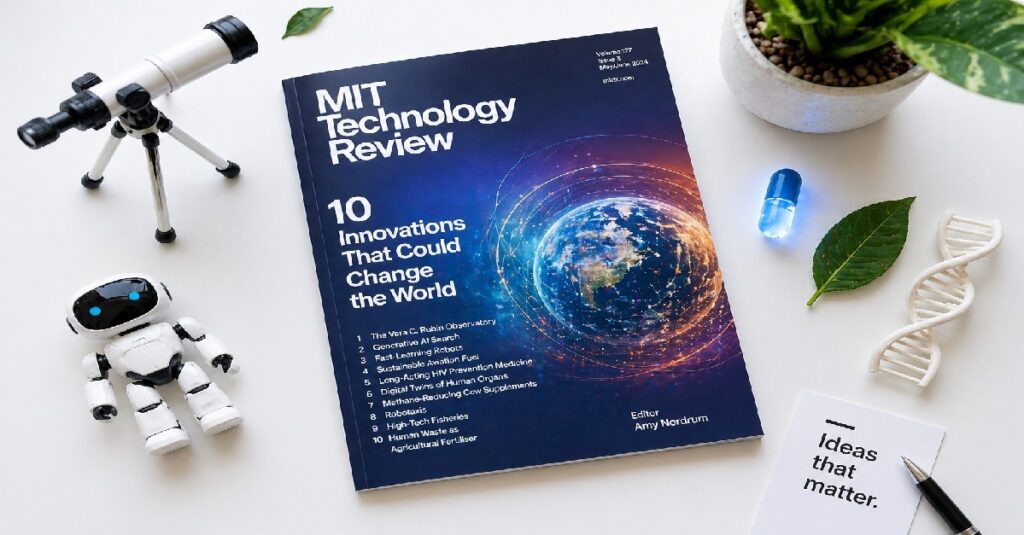
The 10 Innovations MIT Technology Review Highlighted For 2025

1. The Vera C. Rubin Observatory – Humanity’s New Eye on the Universe
Deep within the northern Chilean mountains sits the Vera C. Rubin Observatory, which is now in its final stages of preparation for use. If you have any interest whatsoever in astronomy, dark matter, or in what humanity is capable of achieving with construction, then this telescope is absolutely monumental.
- This observatory is armed with the largest camera ever built in the world to observe space. It will be capturing images of the southern sky every three days for the duration of ten years.
- Every three days, remember. The amount of information that it is going to generate is difficult to comprehend.
- Billions of new astronomical objects will be documented. Detailed maps of the Milky Way galaxy will be created.
- It will allow scientists to understand the fundamentals of dark matter and dark energy on an entirely new level.
- To put it in simple terms, imagine upgrading a disposable camera to a 3.2-gigapixel IMAX camera that perpetually points into the depths of space for a decade straight.
- Astronomers are practically bouncing off the walls with excitement at the prospect of having access to such a vast and detailed source of information.
- It is expected that the Vera C. Rubin Observatory will revolutionise humanity’s understanding of the universe’s structure.
- Spin-off applications of this technology are expected to greatly advance large-scale image processing and data management, far beyond its primary astronomical purpose.
2. Generative AI Search – How We Find Things Is About to Completely Change
Admit it: you have had some pretty strange results pop up after performing a search query, be it in Google or Bing. Well, you are certainly not the only one!
- However, despite the awkward early prototypes, MIT is betting that generative AI search is indeed a breakthrough innovation. The idea behind this is quite simple. Instead of offering you a list of blue links as has been standard for the last twenty-something years,
- AI-powered search systems will be able to intelligently synthesise the results from many sources and deliver to you a concise, coherent summary.
- This isn’t just limited to text-based searches either; it will also work for images, documents, and videos stored on your computer or personal device.
- Overall, this is a potential complete overhaul to the way we search and consume information from the internet.
As AI systems are rapidly evolving, check out the developments being made in AI technology on BHTNews; they’ve been keeping close tabs on this particular trend.
3. Fast-Learning Robots – The End of the Single-Task Robot
One interesting point to ponder is that historically, robots were extremely expensive one-trick ponies. You could train a robot to weld a car door, but you couldn’t really ask it to make you a cup of coffee.
- The difficulty in training robots in the past was largely attributed to data scarcity; it took enormous amounts of time and effort to teach a physical robot general skills and tasks. But that has drastically changed.
- Because of recent breakthroughs driven by the generative AI boom, researchers are able to combine sensor data, teleoperation imagery, and scanned videos from the internet to dramatically reduce the amount of time and effort needed to train robots.
- The upshot is, instead of relying on rigid, preprogrammed routines, we are getting closer to truly general-purpose robots that can operate in warehouses, hospitals, construction sites, and even in our own homes.
- One great example is training a robotic arm to perform the dishwashing task, simply by combining data from a wearable robot, robotic arm video footage, and YouTube videos of humans performing the same action.
Watch out: we’ll see fast-learning robots appearing in the commercial sphere in 2-3 years and in our homes in the next decade.

4. Sustainable Aviation Fuel (SAF) – Clean Skies Might Actually Be Possible
Flying is one of the most difficult industries to fully decarbonise. You cannot exactly plug a commercial aeroplane into a socket.
- This is precisely why sustainable aviation fuel (SAF), which is derived from sources like used cooking oil, industrial waste, or even recaptured carbon from the atmosphere, is such a significant breakthrough.
- Although SAF has been discussed for quite a while, the focus on scaling production and adoption, and the emergence of factories designed specifically for this purpose, are what make it a TR10 breakthrough.
- Governments around the world are starting to require airlines to use SAF, and importantly, the economics are finally becoming viable.
- This technology does have its shortcomings; flights fueled entirely by SAF will still release carbon dioxide when burned.
- However, its lifecycle emissions are drastically lower than conventional jet fuel, ranging from 50% to 80%.
In addition, the growing use of cloud technology and 5G will make streamlining the logistics of SAF distribution possible.
5. Long-Acting HIV Prevention Medicine – 100% Protection. That’s Not a Typo
Honestly, I had to double-take when I read about this one on the list. A recent clinical trial involving a new injectable HIV prevention medicine called lenacapavir demonstrated that, among the women and girls who received the drug, all of them were protected from HIV infection.
- Achieving this 100% success rate in a clinical trial of an infectious disease preventive is extraordinary; traditional daily pills can be very effective, but they suffer from inconsistent adherence rates.
- However, a long-acting injectable, which only requires six-month injections, circumvents this problem completely.
- Currently, there are over 25 clinical trials being conducted for long-acting HIV prevention medicines, and this one is particularly groundbreaking.
This breakthrough could have truly life-changing effects. Millions of people around the world are still infected with HIV each year, and a twice-yearly injection that provides full protection could completely alter this paradigm.
6. Digital Twins of Human Organs – Surgery Rehearsals on a Virtual
It’s been standard practice in manufacturing for years – take a model of a machine, run some scenarios on it, and figure out potential problems before you implement them on the real thing. And that concept has finally landed in medicine.
- Digital organ twins – precise, digital models of a patient’s own heart, liver or tumour built from scans and other data – allow surgeons to plan and rehearse highly complex operations before ever touching a scalpel.
- And that’s not all they will soon do; in the future, some pharmaceutical drug testing will be moved on to digital organ models instead of actual patients, meaning a potential acceleration in drug development and safer, more tailored treatment plans.
- What it’s used for now: Planning surgical procedures in cardiology and neurosurgery with patient-specific models.
What it could be used for in the future: Reduce the time from years to months in the drug testing cycle.

7. Methane-Reducing Cow Supplements – The Climate Tech You’d Never Expect
OK, I know. Out of everything on this list, this is probably the least glamorous-sounding concept. Stick with me on this.
- Agriculture – specifically livestock – accounts for 14.5 percent of all human-caused emissions. And a large portion of these comes from methane produced during cow digestion. Or, put simply, cow farts are a real problem for the climate.
- New feed supplements that can, and have already been proven, to significantly reduce a cow’s methane output (while also potentially increasing their milk and meat yield, giving farmers a direct financial reason to invest) are set to tackle this issue.
- In Denmark, a plan has already been rolled out to tax livestock emissions from 2030 and give rebates to farmers who adopt methane-reducing feed.
Getting farmers to adopt the technology will be a huge hurdle to overcome, but the science is sound.
8. Robotaxis – the Self-Driving Comeback no One Expected
When did it seem like everyone predicted fully-driving vehicles would be commonplace in 2020?
- It didn’t actually work out like that at all. But the fact of the matter is, robotaxis are actually here, and functioning in the real world. With companies like Waymo and China’s Pony.ai already operating fully autonomous vehicles in several cities across the United States and beyond, respectively, and with the public now able to ride along for as long as they can stand it, it appears the days of a quick rise followed by a humiliating fall have finally passed.
- This is the first time in the history of robotaxis that any company has even got to the stage of offering truly commercial service; previous failures, like that of Uber, demonstrate that widespread adoption will be a long way off due to infrastructure, regulation and the trust of consumers.
9. High-Tech Fisheries – AI Helping to Restock Oceans
China is by far the largest consumer of seafood in the world. It has therefore, as you would expect, also made massive investments in tech-driven aquaculture – using AI and robotics to run fish farms and employ techniques for restocking oceans – rather than allowing fish stocks to be decimated by wild catching.
- What is striking about this one isn’t just that it makes the list of breakthrough technologies; it’s that the sheer problem being addressed is enormous.
- Fish populations are being wiped out, and sustainable aquaculture could offer a viable solution; this one seems like a genuinely sensible way to solve one of the planet’s biggest food security issues.
10. Human Waste as Agricultural Fertiliser – a Truly Real Circular Economy Idea
You’ll have to look past the yuck factor, because this one is genius. Synthetic fertilisers require massive amounts of energy to produce, and contribute enormously to the pollution of waterways.
- New techniques, however, now allow us to process human waste, or biosolids (treated sewage sludge), and then efficiently convert it into agricultural nutrients which can be fed back into farmland.
- A truly circular approach applied to one of the oldest issues human civilisation has ever faced – feeding itself sustainably.
What Makes MIT Technology Review’s List Different From the Hype
The trick to TR10 is not just the number of breakthrough technologies that MIT Technology Review highlights in its annual TR10; that’s impressive, it’s also the ones that get left off the list, too.
- Technologies that are considered overhyped, those that have not yet reached the tipping point, or those that are interesting but are deemed unlikely to make an impact over the next decade are excluded.
- BCIs, for example, while an undoubtedly cool technology, are judged by TR to still have passed the tipping point that MIT Tech Review considers worthy of inclusion.
- So brain-computer interfaces have failed to make the 2025 cut, a trend that is indicative of the quality of TR’s curating.
Executive editor, Amy Nordrum, explained that “progress isn’t always linear, some of these technologies have had real setbacks and gone through periods where it wasn’t clear that they would ever succeed”.
The Bigger Picture: Three Themes Running Through the 2025 List
A candid approach, which I greatly admire. Three overarching themes. The biggest thing that stands out when looking at this year’s list of 10 breakthrough technologies is three key themes that cut across many of them.
1. AI as the Acceleration, Not the End
- The number of technologies that have been directly influenced by generative AI cannot be overstated.
- From smart robots to the digital twin to aquaculture, AI is acting as a catalyst, finally enabling a lot of the breakthroughs that have been conceived and discussed for decades.
2. Climate Tech’s Move to the Operational Phase
- Green-tech, which has been the subject of scientific discussion and debate for years now, has reached a new point where it is truly starting to take hold.
- The large-scale infrastructure and regulatory changes that have been implemented have put the economics of many climate solutions firmly into place and seen green technology take over from just an aspirational ideal.
3. Medical Innovation Driven by Individual Requirements
- Individual treatment is on the horizon in the shape of long-acting HIV prevention, digital organ twins and stem-cell therapy.
- These individualising treatment approaches represent the very beginnings of an age where medicine is tailored to the needs of individuals, rather than populations and can be largely attributed to new AI-driven systems that are also revolutionising fields such as content creation with AI video generators, a subject that MIT Technology Review is also keeping a close eye on.
Why You Should Follow MIT Technology Review
The first thing to do is subscribe to their free, daily e-newsletter (about five minutes of reading). Their TR10 Archive is also very useful – going back to the 2010 list, you’ll see how good they are.
- MIT TechReview also offers its own conferences on technological innovation throughout the year and publishes an annual January issue focusing on its chosen TR10 breakthroughs, which would be ideal to look at.
- MIT Technology Review is an excellent publication regardless of whether you’re an industry insider, a scientist, or just someone with an interest in the future, but its focus on providing insights into technology with the potential to have a real impact really makes it worthwhile.
Final Thoughts: Why This List Is Worth Your Time
So, why bother reading the TR10 list? For me, what sets this list apart from every other tech-related headline out there is its ability to look beyond what is exciting and innovative, and into what is important.
- The TR10 doesn’t set out to generate clicks; instead, it asks the very difficult question: which innovations will truly matter to future generations.
- In an era where tech seems to evolve at warp speed, the one thing I noticed that united all of these 10 breakthrough technologies is that they have a lot in common.
- They aim to enhance and optimise existing technologies that are already beneficial and help them become useful for all, not just the rich.
Frequently Asked Questions About MIT Technology Review
What is MIT Technology Review Known For?
MIT Technology Review is a completely independent media company wholly owned by the Massachusetts Institute of Technology. It is known for its deeply reported technology journalism, its famous annual ’10 Breakthrough Technologies’ report and in-depth exploration of how the latest technologies are affecting business, policy and society. Since it was established in 1899, it has become one of the longest-running and most well-respected tech publications on the planet.
Is MIT Technology Review Free to Read?
MIT Technology Review publishes some content for free online, including selected articles and the Download newsletter. More in-depth reporting, as well as the full annual innovation report and premium articles, require a digital subscription. Academic and institutional access is also available.
How Does MIT Technology Review Choose Its 10 Breakthrough Technologies?
Over the course of months, the editorial team combs through hundreds of technologies across consumer technology, biomedical science, climate solutions, artificial intelligence, computing and more. What they are looking for is technologies that have finally crossed the threshold: the threshold between concept and reality or between the obscure and the scaled-up. The goal is always to omit hypemachine hype in favour of technologies at a true point of inflexion.
Is MIT Technology Review Affiliated With MIT?
Both and neither. While MIT Technology Review is owned by MIT, it remains an editorially independent media company. MIT itself cannot influence its editorial coverage. Its relationship is more akin to how the university press can operate independently of the university’s academic departments, even while being linked to them through the university name.
What are the Most Important MIT Technology Review Innovations of 2025?
Vera C. Rubin Observatory, generative AI search, fast-learning robots, sustainable aviation fuel, a long-acting HIV prevention medicine, digital organ twins, cow-feed additives for cutting methane production, robotaxis, sophisticated high-tech fisheries and human waste as agricultural fertiliser are the ‘TR10’ innovations of 2025 and are covered in depth above-scroll up to the relevant section for more details.
How Accurate have MIT Technology Review’s Past Predictions Been?
So accurate as to be almost uncanny. In the past, the TR10 has picked up natural language processing (2001), wireless power (2008), reusable rockets (2016), long before they were common technology trends. Not all of its predictions have proved to be true-the TR team admits some were a little off-but the overall hit rate is strong enough that even investors, researchers and policy makers pay attention.
Can I Read MIT Technology Review without a Subscription?
You can read one article each month without subscribing. It is also possible to sign up for its fully free newsletter. Full access to the content and all the TR10s is through a paid digital subscription (available at a student rate, too).
| CALL TO ACTION: Which of these 10 innovations are you most excited about? Drop a comment below — we’d love to know. And if this breakdown was useful, share it with someone who geeks out on this stuff as much as you do. Stay curious, stay informed, and keep reading BHTNews for the latest in tech and AI. |