







Will AI suddenly “wake up,” get feelings, and swipe your job by next week? Not really. No. Not even close.
That’s the short answer to a question that’s been keeping a lot of people up at night, and it’s worth saying up front because so much of what circulates online about AI myths vs reality gets this backwards.
I’ve spent a good chunk of the last few years writing about this stuff, and I still get messages from friends asking if their jobs are “safe” from robots that, frankly, don’t exist yet. This piece is my attempt to clear the fog.
We’ll walk through what artificial general intelligence actually means (hint: it’s not what’s running your chatbot), why AI doesn’t “think” the way you do, and why the job apocalypse headlines are missing the more interesting story.
Table of Contents
AGI vs. Narrow AI: The Mix-Up That Started It All
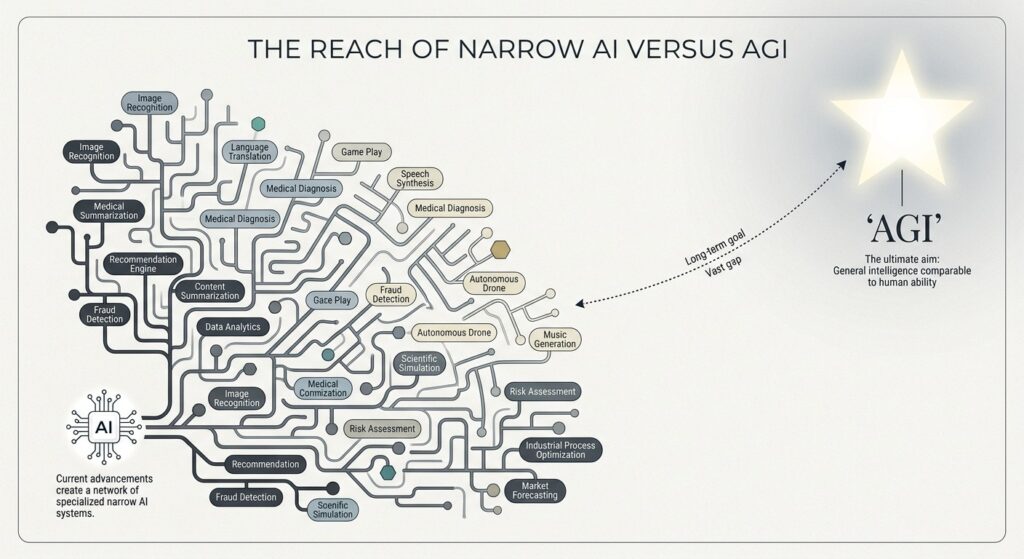
Here’s where most of the confusion begins. Whenever someone talks about “AI,” people usually picture some futuristic movie scene like a digital brain that can do anything a human can.
That’s called Artificial General Intelligence, or AGI. And, honestly, we’re just not there. Not at OpenAI, not at Google, not anywhere.
What we actually have and use every day is narrow AI. Right now, AI’s really good at specific stuff: writing your emails, churning out contracts, whipping up images, even keeping up a pretty convincing chat. But it doesn’t actually generalize as we do.
The same system that writes perfect Python code can still drop the ball on a logic puzzle a kid would breeze through. That’s not a bug you can patch away. It’s a structural feature of how these systems are built.
Even the newest wave of “agentic” models the ones that can plan multi-step tasks and use tools on their own are still narrow AI with a longer leash. Yeah, AI can tackle linked-up tasks better than before.
But it’s not suddenly self-aware or steering its own ship, despite what all those sci-fi fantasies suggest.
Does AI “Think” or “Feel”?
Look, I totally get why it seems alive sometimes. You type out a question, and the answer just pops out fluently, sometimes even funny. The reality? Deep down, all those fancy models are just guessing the next likely chunk of text based on mountains of data they’ve soaked up. That’s really all it is. There’s no inner monologue, no desire, no experience of being right or wrong.
Think of it like an incredibly advanced autocomplete one that’s read basically the entire internet and gotten scary good at guessing what word (or code snippet, or paragraph) comes next.
It doesn’t know what it’s saying is true any more than a calculator “knows” what 7 times 8 means. It’s just very, very good at the math of language.
This matters because when a model gets something wrong, makes up a fact, or invents a citation, it’s not lying in the human sense. It’s not capable of intent.
And sometimes those predictions miss badly. If you start believing it’s actually thinking or feeling, you’re way more likely to trust answers you shouldn’t.
The Job Displacement Myth: What About the Job Panic?

This is the big one. I get the worry, honestly. Headlines love a scary number. But the “AI will replace all jobs” story oversimplifies something messier and, honestly, more interesting: human-AI collaboration.
Recent labor research backs this up more than the doom headlines suggest. AI does wipe out some routine tasks data entry, simple transcription, those basic support scripts.
Still, it also kicks up new kinds of work. Now we need people to fine-tune AI models, double-check their output, adapt them to real industries, or just do the parts that take judgment, empathy, or actual accountability.
A friend runs a small marketing shop. Practically every blog post and ad draft the team spits out starts with AI now. Did that kill jobs?
In a way, she doesn’t need as many junior writers grinding through rough drafts all day. But her editors? Busier than they’ve ever been.
Someone has to fix the robo-mistakes, turn bland sentences into something that pops, and make sure clients don’t sound like, well, a robot. Which, well, it did. The work didn’t vanish. It moved.
Where Do These Myths Even Come From?
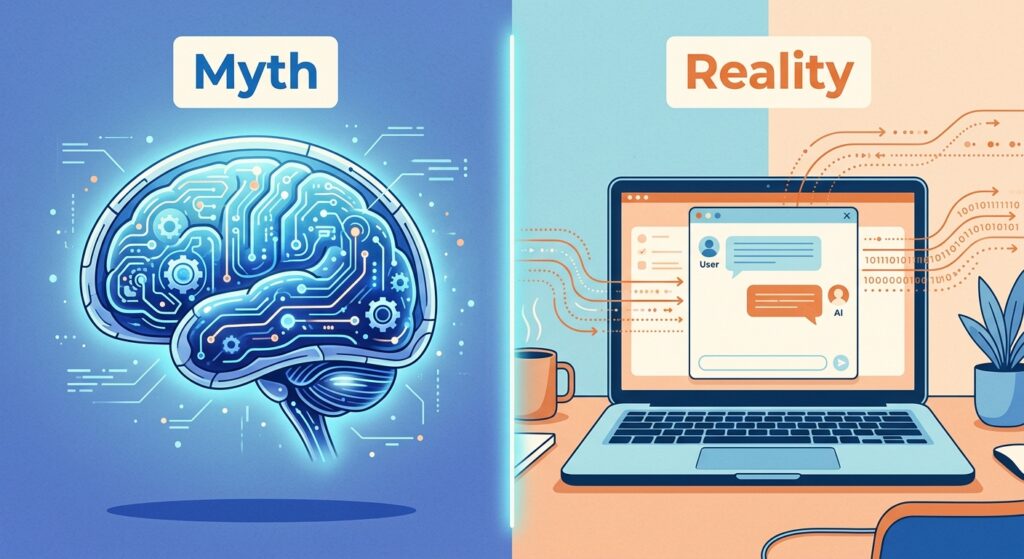
A few obvious culprits: decades of science fiction that trained us to expect either a helpful robot friend or a rogue machine overlord, nothing in between.
Marketing copy from AI companies that leans hard into words like “revolutionary” and “thinks like a human” because it sells subscriptions.
And frankly, media coverage that rewards alarming headlines over nuanced ones.
None of that means the risks around AI aren’t real. They are bias in training data, job market disruption in specific sectors, energy costs, misuse for scams and deepfakes.
But those are concrete, addressable problems. They’re a lot less dramatic than “the robots are becoming conscious,” and a lot more useful to actually think about.
What’s Actually True About AI in 2026
Let’s ground this in what’s real right now:
- Narrow, not general. Every commercial AI system today is trained for a bounded set of tasks, even the flexible-feeling ones.
- Pattern-matching, not reasoning like a human. Models generate statistically likely responses; some newer systems simulate step-by-step reasoning, but it’s still a computational process, not lived understanding.
- Collaborative, not wholesale replacement. Most real-world deployments pair AI with human oversight; the technology augments judgment rather than replacing it outright.
- Still makes mistakes. Hallucinations, outdated information, and confidently wrong answers remain a real limitation, which is exactly why human review still matters.
- AI is actually useful—just not in all the ways the hype machine wants you to believe. It’s sharp in specific spots, not some magic fix-everything tool.
So What’s the Takeaway?
- Real AI isn’t as dramatic as the pop culture myths, but it’s still changing how we work.
- We’re not living with a sentient digital roommate, and we’re not all getting replaced overnight.
- We’re in the thick of a messy, uneven transformation of certain tasks.
- The people who’ll actually thrive?
- They’re the ones willing to team up with these tools, not just freak out or put them on a pedestal.
- Wondering how this really hits your industry, not just the headlines? Start with your own job.
- Which parts are repetitive and follow patterns?
- Which parts really need your judgment?
- That’s where you’ll see whether AI is actually helpful, or just hype.
Frequently Asked Questions
Is today’s AI conscious or self-aware?
Nope. Today’s AI has zero awareness. It processes patterns and spits out what’s statistically likely; no inner world or subjective experience. Just because it sounds smooth doesn’t mean there’s anything “in there.”
How close are we to AGI?
No one knows seriously. Some think we’re a few years away, others say decades (or never). What we’ve got now is still narrow, good at one thing at a time, nothing close to flexible reasoning across the board. Anyone who gives you a date is just guessing.
Will AI erase my job?
Depends a lot on the job, but getting totally wiped out isn’t the norm. It’s usually certain tasks that change or disappear. Most jobs mix in things machines can’t really do, so you’re more likely to see your job shift, not vanish. Anything built around real judgment, actual relationships, or accountability? A lot safer.
Why does AI sound so human sometimes?
AI trains on mountains of human-written stuff, so it gets the rhythm and tone and style down. That’s where the fluency comes from; it’s just really good mimicry, not real understanding. Sounding human and actually thinking like one? Two completely different things.