












Table of Contents
Introduction
A full-service marketing agency is basically your all-in-one team—strategy, creative, digital campaigns, content, sometimes PR—handled by one group, under one contract.
The big draw? You get one point of contact, one invoice, and a team that’s supposed to really understand your business.
But whether this setup works for you depends on where your business is at, your budget, and how much you want to be involved.
This guide breaks down what these agencies actually offer, how they stack up against specialists, what you’ll pay, and how to check if the agency’s legit before you sign off.
Quick Answer
- A full-service agency wraps up strategy, content, SEO, paid media, social media, creative, and often web and PR into one bundle, handled by one account team.
- It’s often best for brands looking for a single partner across several channels, especially if you don’t have time to manage multiple vendors.
- Pricing is usually a monthly retainer, but agencies might offer project-based or performance-based fees too.
- The biggest vetting priorities: who actually staffs your account, what they subcontract, and how they report results
What Is a Full-Service Marketing Agency?
A full-service marketing agency is an agency that plans and executes a brand’s marketing end to end — strategy, content, SEO, paid media, social, creative, and often web and PR — under one contract and one account team, instead of a business hiring separate specialists for each channel.
So, what do these agencies actually do? They bring together their in-house specialists—strategy folks, designers, writers, media buyers, analysts—so your campaign flows from research through creative to launch all in one place, without being passed off to separate contractors.
Many of these shops also describe themselves as a full-service digital marketing agency when most of that work happens online, though the better ones can still run offline and traditional campaigns when a brand needs them.
That doesn’t mean every full-service agency is equally strong in every discipline. Most have a few areas they’re genuinely excellent at and others they handle competently but subcontract out or lean on junior staff for.
Asking which is which, for your specific needs, is one of the more useful questions you can ask during vetting — covered in the checklist below.
What’s Included?
Most full-service agencies cover a combo of strategy, content, SEO, paid media, social, creative work, web, analytics, and sometimes PR.
| Service Area | What It Usually Covers |
| Strategy & brand positioning | Market research, competitive analysis, brand messaging, and an overall marketing plan tied to business goals |
| Content marketing | Blog content, long-form articles, email newsletters, and other owned-content production |
| SEO | On-page optimization, technical SEO audits, and organic search strategy |
| Paid media | Search ads, social ads, and display/programmatic campaigns, including budget management |
| Social media | Organic content, community management, and platform strategy |
| Creative & design | Branding, graphic design, video production, and campaign creative assets |
| Web design & development | Website builds, landing pages, and ongoing site maintenance |
| Analytics & reporting | Performance tracking, campaign reporting, and attribution across channels |
| PR & communications | Media relations, press outreach, and reputation management (not every full-service agency includes this) |
But honestly, PR and a few other things aren’t always part of the package, so don’t assume “full-service” means everything—ask up front for the exact scope.
Full-Service vs. Specialists: Which Should You Choose?
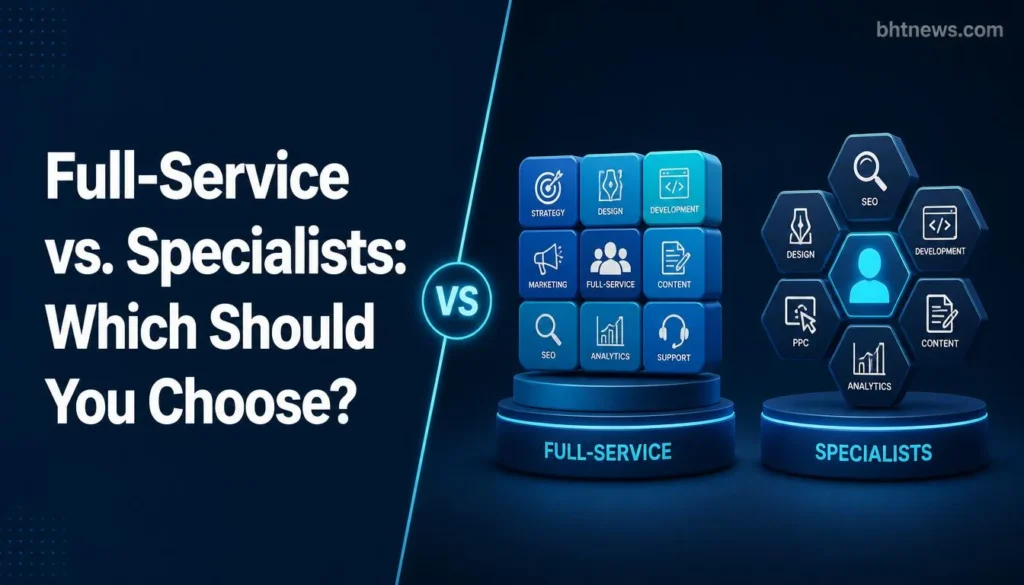
Honestly, there’s no clear winner. The debate pops up almost every time someone’s hunting for an agency. What matters is whether you need a single point of contact and want one team managing everything, or if you’d rather piece together specialists and handle the coordination yourself.
| Factor | Full-Service Agency | Specialized Agency |
| Coordination | One team, one strategy, minimal cross-vendor management on your end | You coordinate across multiple vendors yourself, or hire someone to |
| Depth per channel | Usually solid across channels, but rarely the deepest expert in any single one | Typically deeper, more current expertise in its specific niche |
| Cost | Often higher overall, but can be more efficient than several separate specialist retainers combined | Can be cheaper per channel, but costs add up if you hire several |
| Flexibility | Harder to swap out one underperforming service without disrupting the whole relationship | Easy to replace one underperforming vendor without affecting the others |
| Best fit | Businesses that want one strategic partner and don’t have bandwidth to manage multiple vendors | Businesses with a specific, well-defined need, or an in-house team that can handle coordination |
When Should You Go Full-Service?
It usually makes sense if you don’t have someone in-house running marketing and want a partner to own the strategy—for a brand launch, product launch, rebrand, or when juggling multiple vendors sounds like a headache.
It tends to be the weaker fit when you have one specific, narrow need — say, technical SEO or a single paid-ad campaign — where a specialist will likely go deeper for less money, when you already have in-house marketing staff who just need execution help in one area, or when your budget can’t support the retainer minimums most full-service agencies require.
Still not sure? Take a look at our small business digital marketing guide—it walks through what you can realistically manage in-house before you start hunting for agencies.
What’s This Going to Cost?
Pricing depends on the agency and your scope, but here are the main ways these deals are structured:
- The Monthly Retainer: Most popular for ongoing work. You pay a fixed monthly fee, covering specific services, usually with a minimum commitment.
- Project Pricing: Flat fee for a defined deliverable (think: brand overhaul or website redesign).
- Hourly or Staff-Time Billing: Less common for full-service, but sometimes used for smaller projects.
- Performance or Commission-Based Fees: Tied to ad spend or campaign results, usually just for paid media—rarely covers the whole relationship.
Rates swing wildly based on agency size, location, and what you need—and they change often. If you see a quote somewhere, treat it as a starting point, not gospel. What works better? Get quotes from two or three agencies for the same scope of work, so you make a real comparison.
How Do You Pick the Right Agency?
Choosing a full-service agency is all about vetting. Follow a structured process so you avoid getting locked into a contract that doesn’t work for you. Here’s what to do:
- Define your scope and budget before you start taking calls. Knowing exactly what you need — and what you can spend — keeps agencies from pitching you services you don’t need.
- Ask to see case studies in your specific industry or a comparable one, not just general portfolio work.
- Ask who will actually work on your account — by name and role — not just who’s in the pitch meeting. Account teams can shift significantly after signing.
- Ask which services they genuinely specialize in versus which they subcontract or staff more thinly. A good agency will tell you this directly.
- Ask how they report results and how often — and ask to see a sample report, not just a description of one.
- Find out the contract length and minimum commitment; check what it takes to leave if things go south.
- Talk to references—actual clients, not just testimonials on their site.
- Compare at least a couple of agencies quoting for the same scope. That way, you’re really seeing who offers the best price and capability.
What Red Flags Should You Watch For?
A few warning signs tend to predict a bad agency relationship more reliably than anything else:
● Vague answers about who will actually staff your account
● Reluctance to share real client references or case studies
● Guaranteed rankings, guaranteed leads, or other promises no legitimate agency can actually guarantee
● Reporting that’s described in general terms but never shown as an actual sample
● Long minimum contract terms with no clear exit clause
Conclusion
So, is a full-service agency worth it? Only if you really need a coordinated cross-channel strategy and don’t want to manage a bunch of specialists yourself—not just because “full-service” sounds tempting.
Before you take any pitch calls, write down what you want, what you can spend, and how you’ll measure success. That’s what turns this checklist from a formality into a real filter.
Frequently Asked Questions

What’s the real difference between a digital marketing agency and a full-service one?
Digital agencies are all about online stuff — SEO, paid ads, social media, emails, the usual suspects. Full-service agencies handle the digital side, too, but they don’t stop there. They also tackle brand strategy, come up with creative ideas, run traditional ads, handle PR, you name it. Basically, everything under one roof.
Is the full-service option pricier than hiring individual specialists?
Honestly, it comes down to what you actually need. If you’re only looking for help in one area, a specialist will probably cost less. But if you need someone to handle everything across multiple channels, a full-service agency usually saves you money (and headaches) in the long run. Managing several vendors eats up your time fast.
How long will it take?
As for the contract, most agencies want you to stick around for at least three to six months. Marketing takes time, especially SEO — results don’t happen overnight. Just watch out for contracts that lock you in for a year or longer without a fair exit clause.
Can these agencies work with your in-house marketing team?
Absolutely. Lots of companies use full-service agencies to boost what their team can do, not to replace them. Maybe the agency handles paid ads and content, while your in-house folks steer the strategy. Get clear on who handles what before you sign anything; otherwise you might end up with confusion or gaps later on.