











Table of Contents
Introduction
Finding the right B2B digital marketing agency is about fit. You want a partner who actually specializes in your biggest challenge, uses a pricing model that matches where your company is, and can back up their claims.
Start by really identifying your core problem—maybe it’s not enough pipeline, maybe those sales cycles just drag, or maybe your organic visibility is weak.
Once you know your pain point, pick the type of agency that solves it. But don’t sign anything yet: test their proof, nail down the contract terms, and look closely at how they’ll report results.
This guide breaks down the different B2B digital marketing agencies, how much they typically cost, how to evaluate them, which warning signs you need to watch for, and how to tell if your agency is actually delivering. We don’t rank specific agencies here—if you need a list of the top names, check out our separate roundup.
First—what exactly is a B2B digital marketing agency? It’s a team you hire from outside your company to plan and run online marketing campaigns aimed at other businesses.
Usually, their work touches some mix of SEO, content, paid media, email, account-based marketing, and analytics. Everything is built for longer sales cycles and the reality that multiple people are involved in each buying decision.
Which Agency Fits Your Problem?
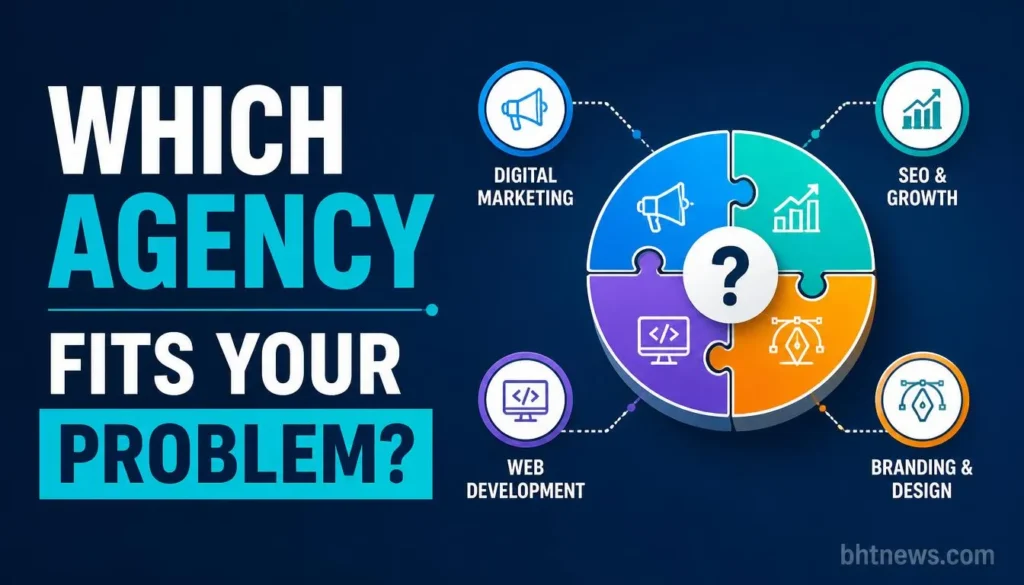
| If your main problem is… | Look for… | Ask them about… |
| Too few qualified leads overall | A demand generation agency | Cost per sales-qualified lead and pipeline contribution, not just clicks |
| A short list of big target accounts that won’t reply | An account-based marketing (ABM) agency | Account selection method, sales alignment and how they report account engagement |
| Weak organic visibility or thin content | An SEO and content agency | Their process, expected timeframe and what they change on your site |
| Paid campaigns that burn budget | A paid media or performance agency | Account ownership, testing plan and how they judge lead quality |
| No marketing team and several needs at once | A full-service agency or fractional marketing lead | Who actually does the work and how channels are prioritized |
| A sales team that needs meetings booked | An outbound or lead generation agency | List sourcing, email compliance, and who owns the data |
How Is B2B Marketing Different From Consumer Marketing?
Selling to businesses isn’t like selling to everyday people. B2B buying takes more time, there are more folks involved, and the path to a deal is seldom straightforward. Gartner lays out six “buying jobs” that B2B buyers tackle, and they don’t just move through them once—they loop back, re-check, and get input from a group of decision-makers.
That’s a big deal when you’re hiring an agency. If you bring in an agency that usually runs consumer campaigns, they’ll chase cheap clicks and fast leads. But B2B buyers? They might read half a dozen web pages over months before ever talking to sales.
According to Gartner, buyers are actually far more likely to close valuable deals when they can use a supplier’s digital tools and talk to sales, rather than going it alone. So, your B2B agency needs to work closely with your sales team, not ignore them.
How Do B2B Marketing Agencies Differ by Specialization?
Most B2B agencies fall into six common types, based on what they do best. Sure, plenty offer a mix of services. But when you pick one, you’re really buying their core strength.
| Type | What they do | Best when | Watch out for |
| Demand generation | Build pipeline through content, SEO, paid media and email | You need steady lead flow across channels | Reports that stop at lead counts and never reach revenue |
| Account-based marketing | Run personalized campaigns to a defined list of target accounts | You sell high-value deals to a small, known market | Needs sales buy-in and clean account data; slow to show results |
| SEO and content | Grow organic search traffic with technical fixes, research-led content and authority building | You want compounding visibility and can wait | Promises of fast rankings or guaranteed positions |
| Paid media | Run and optimize search, social and display advertising | You have budget and a tested offer | Agency-owned ad accounts; optimizing for cheap leads over good ones |
| Outbound / lead generation | Source contacts and run email or LinkedIn outreach to book meetings | Sales capacity is ready, and the market is reachable | Weak list quality and compliance risk |
| Full-service | Cover strategy, content, paid, SEO, and reporting under one roof | You have no in-house team | Spread thin; junior staff on your account |
On account-based marketing (ABM): HubSpot puts it simply—ABM is “a targeted approach where sales and marketing collaborate closely to target high-value accounts.” Translation: this only works if your sales team is truly involved from the get-go.
If you sell SaaS
Agencies that get SaaS should be able to explain your growth motion—are you product-led (think free trials or freemium) or sales-led (where it’s all about demos and contracts)? The funnels, numbers, and campaigns are different for each. If you’re product-led, ask how they measure trial-to-paid conversions. For sales-led, ask how they connect campaign activity to pipeline opportunities in your CRM.
- Always ask if the agency’s worked with SaaS startups at your price point and growth stage.
- Make sure they know how to get inside your CRM and analytics—don’t settle for just getting reports from their side.
- Be careful if they throw around benchmarks without real sources or timelines.
If you sell technology and need organic search
Tech-focused B2B SEO is tough. The audience is more specialized, and buyers want details—they do tons of comparing and research. The most important questions: Can the agency’s writers handle your tech topics? Will they work on your product and comparison pages (not just blogs)? What results do they realistically expect, and when?
Google’s own guide for hiring SEOs says nobody can guarantee a #1 ranking. Ask for specifics: what do they expect to achieve, by when, and how will they measure success?
If you’re a small business that just needs leads
Most B2B lead-gen agencies for small companies sell outreach—email, LinkedIn, or calling—or paid campaigns meant to get you meetings right now. They’re not about brand building or long-term organic reach; think quick tests to see if a market bites. The catch is that quality depends on where they get their contact lists and how they handle compliance.
And here’s the legal bit: the FTC’s CAN-SPAM Act makes no exceptions for B2B email—each violation can cost over $53,000 per message (and that’s as of 2024). Grill any outbound agency on where they source contacts, how they handle opt-outs, and who shoulders legal responsibility. At the end of the day, you could be on the hook if they mess up.
How Much Do B2B Digital Marketing Agencies Cost?
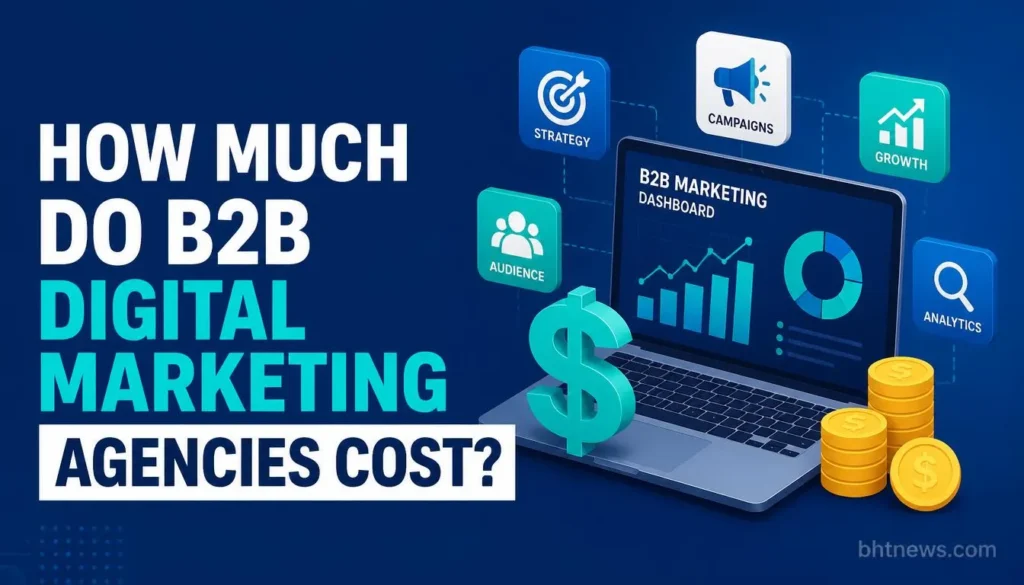
Most agencies don’t put prices online. The numbers below are from SaaS Hero’s 2026 pricing guide—a marketing tool from an agency that sells flat-rate retainers. They pull some stats from outside sources, but we didn’t vet every number, so treat these as rough guidelines.
| Pricing model | Typical range (per SaaS Hero) | Works best when |
| Flat monthly retainer | $2,500 to $15,000 a month for many B2B programs | You want predictable spend and ongoing work |
| Percentage of ad spend | 10% to 20% of monthly media budget, often falling as spend rises | Paid media is the main channel and spend is large |
| Project fee | Brand strategy $5,000 to $20,000; website redesign $15,000 to $80,000+ | You need a defined deliverable, not ongoing work |
| Hybrid (base plus performance) | A base fee plus payments tied to meetings or sales-qualified leads; no range given | Your CRM can reliably track outcomes |
| Freelancer or single function (early stage) | $1,000 to $5,000 a month for pre-seed and seed companies | You need one function done, not a team |
Take the percentage model: if an agency charges 15% of your $50K monthly ad spend, that’s $7,500. Make them spell out if that’s on top of your $50K budget, or if it comes out of it. Ask what’s included—does it cover setup, tools, reporting? SaaS Hero says a 1,000–2,000 setup fee is reasonable, but anything higher should come with a detailed breakdown.
Heads up: Even on their own page, SaaS Hero gives slightly different numbers for their own packages. It’s a reminder—get a detailed, written proposal and know your total monthly cost before you agree to anything.
What Are Your Options When the Budget Is Tight?
If you’re on a budget, you’ll find affordable B2B agencies go narrow, not broad: pick one channel, aim for one clear goal, and keep the scope focused. Go for a full-service retainer before you know what works? You’ll usually just spread your budget too thin.
- Hire for just one specialty. A freelancer for SEO, paid search, or email will cost a lot less than a whole agency (SaaS Hero pegs early freelance help at 1,000–5,000 a month).
- Buy a one-off project, not a monthly retainer. Need a website fix, a positioning workshop, or better analytics? Just tackle that for now.
- If you lack someone to steer the ship, bring in a part-time marketing lead to handle strategy and wrangle a few contractors.
- Do the prep work in-house: nail your ideal customer profile, set up your CRM, and make sure your forms are tracked. Agencies can’t fix what you aren’t tracking.
- Always set a short test—fixed scope, quick review (say, three months), and a clear exit if it’s not working.
How Do You Vet a B2B Digital Marketing Agency?
Here’s how to dig in: know your own goal, build a shortlist from several different sources, check for real proof, and ask pointed questions during your first call. Reading pretty websites doesn’t tell you what working with an agency feels like—talk to people.
- Write down one clear, measurable goal for the next two quarters—“double our qualified leads from organic search” or “book at least 15 meetings with target accounts.” Stick to your plan, not theirs.
- Build a shortlist of three to five agencies. Mix referrals from peers, industry directory results, and your own research. Never pick from one ranking alone.
- Read the reviews on directories (see below), then check if the agency works with businesses your size and industry.
- Ask for a couple of references you can actually speak to, and specifically ask what happened when things went sideways.
- Compare written proposals for scope, reporting, and cost—not just creativity or a clever pitch.
- If you can, start with a paid pilot or a small first project to test the waters.
Can you trust directory rankings?
Directories like Clutch are a good place to find agency names, but don’t treat their rankings as gospel. Clutch reviews do go through some verification, but agencies can pay to show up at the top. Sponsored placements come first, then “verified” agencies, then the rest. Paid position doesn’t change the agency’s actual rating, but it definitely changes what you see first.
Discovery-call questions worth asking:
- Who will actually work on my account day to day, and how much of their time will they spend on us?
- Which current or past clients are most similar to us? Can I talk to one?
- What’s your plan for my first 30, 60, and 90 days? What should I expect to see each step of the way?
- What metrics do you report, and will those tie directly to pipeline or revenue?
- Will ad accounts, analytics, and CRM data be in my company’s name, with me as the admin?
- What tools and data will you need from us, and what kind of access will you request?
- If results fall short, what’s the process for ending the contract?
- What aren’t you good at, honestly—and where would you send us instead?
What Are the Red Flags?
Biggest red flags: guaranteed outcomes, secrecy about methods, or an agency refusing to give you admin access to your own accounts.
Google flags things like a guaranteed #1 ranking, agencies promising “special relationships” with Google, being hush-hush about their process, or cold-emailing you SEO offers.
Also watch for these:
- The agency holds the only admin access to your ad or analytics accounts. If you break up, you could lose everything.
- Their case studies don’t include a baseline, a timeframe, or a client you can contact.
- Their reports only show impressions and clicks, not what matters for revenue.
- The contract locks you in for months with no clear way out if things go wrong.
- They claim to be “top-ranked” on a paid directory slot.
- (See the table above for more.)
What Should a B2B Agency Contract Cover?
Quick disclaimer: This isn’t legal advice. Always get a real lawyer to review contracts.
You want an agreement that’s clear on the project scope, price, term, exit options, and who owns what. Review these:
- Scope and deliverables: What’s included each month? What costs extra? What’s NOT included?
- Term and exit: Minimum commitment, notice period, and any early-termination fees. Shorter terms or a pilot help you avoid risk.
- Ownership and access: All your core accounts—ad, analytics, CRM, website, content—should be in your name, not the agency’s. Google’s own advice: only give read-access to Search Console while getting an SEO audit, and ask about any changes they make to your systems.
- Reporting: How often they’ll send reports, in what format, which metrics, and whether you’ll have direct dashboard access.
- Subcontractors and data: If they outsource, know who’s actually handling your information and how data privacy is managed.
- Compliance: Who’s on the hook for complying with email laws, ad rules, and platform terms.
How Do You Measure Whether an Agency Is Working?
Judge the agency by pipeline and revenue influence—not just by activity. Numbers like “posts published” or “impressions” show they’re busy, but things like “sales-qualified leads,” “opportunities,” and “closed revenue” show they move the needle.
B2B attribution isn’t perfect. Buyers don’t follow a straight path; you’ll miss a lot if you only look at last-touch reports. Agree on reporting before work starts, and add a “How did you hear about us?” field to your forms—it helps you catch what your tracking misses.
Results come at different speeds, depending on channels. Paid campaigns give you early data in a few weeks; SEO or ABM take a while longer. With SEO, for example, Google won’t give a generic timeframe, so have that conversation with any agency you’re considering. Set leading indicators (traffic, form fills, booked meetings) for the first 90 days, and focus on revenue after that.
Three Illustrative Scenarios
| Situation (hypothetical) | Reasonable direction | Why |
| Seed-stage SaaS with a small budget and a working product | One specialist or freelancer for a single channel, such as search ads or SEO, on a short-term basis | A narrow test shows which channel works before you commit to a larger retainer |
| Series B SaaS with a sales team and a list of target accounts | An ABM-focused agency with sales alignment, or a full-service team that includes ABM | The problem is reaching named accounts, which general lead generation doesn’t solve |
| Small IT services firm that needs meetings quickly | A lead generation or outbound agency with clear compliance practices, plus a pilot | The goal is meetings, but list quality and email law need checking |
What Should the First 90 Days Look Like?
Your first three months with an agency should cover setup, a first round of work, and a review. Here’s one way to break it up:
- Days 1–30: Get access to your accounts. Run a tracking audit. Gather baseline numbers. Agree on clear goals. Build the plan.
- Days 31–60: Launch first campaigns or content. Have regular check-ins to troubleshoot and adjust.
- Days 61–90: Review leading indicators against the plan. Fix weak spots. Decide if you’re sticking with the agency, shifting tactics, or moving on.
Conclusion
Picking your B2B digital marketing agency always comes down to fit: match what the agency’s great at to your biggest pain point, make sure their pricing and ownership details make sense, and judge them on actual pipeline results—not just showing you’re busy. Most times, a cheap, focused project with an easy exit is safer than locking into a big retainer before you’ve seen any work.
Remember, this is general advice—not legal or financial counsel. Prices, directory policies, and platform rules all change, so double-check the specifics with the agency and a pro before you sign.
Next step: Write down your must-move metric, shortlist three agencies that specialize in your type of problem, and bring those eight must-ask questions to every discovery call. Ready for agency names? Go check our B2B agency roundup.
Frequently Asked Questions
How many B2B agencies should I shortlist?
Go for three to five. Fewer than that, and you’re not really comparing; any more, and the process gets messy.
Is a retainer or project fee better?
Retainers work for ongoing stuff—content, SEO, or paid media. Projects are best for one-offs, like rebuilding your site or a strategy workshop. Retainers give you predictability, but get deliverables in writing whatever you do.
How long to see results from a B2B agency?
It depends on the channel and your sales cycle. Paid campaigns: weeks. SEO and ABM: longer. Google doesn’t offer a set SEO timeframe—ask the agency for their own benchmarks and set leading indicators for the first 90 days.
Specialist or full-service agency?
Pick a specialist if you know what needs the most work. Pick full-service if you have no marketing team and need help everywhere. Specialists tend to go deeper; full-service offers one point of contact. Wherever possible, double-check who is actually doing the work.
Can an agency guarantee rankings or lead numbers?
No reputable agency can guarantee top search rankings. Google itself says, “No one can guarantee a #1 ranking on Google.” For guaranteed leads, ask exactly how they define a “lead” and what happens if they fall short.
Who should own ad and analytics accounts?
You should. Set things up in your company’s name. If the agency owns your accounts, you could lose everything if you split ways. It’s standard practice, but always confirm in your contract.
In-house hire or agency?
In-house hires give you control and deep product knowledge, but nobody is an expert at everything. Agencies bring breadth and speed, usually at a monthly fee. Many teams use one in-house lead and agencies or freelancers for everything else.