
The best entrepreneurship articles for students do three things: they teach you how to spot real problems, test an idea cheaply before you sink any cash into it, and handle the basics like costs and taxes.
This guide features eleven essential documents spread across ten curated recommendations (our top research pick includes two sources). We cover everything you need to launch successfully, including:
- Startup Strategy: Classic essays on startup ideas by Paul Graham.
- Business Planning: Straightforward advice from the SBA.
- Tax Compliance: Official IRS rules on self-employment.
For each pick, I’ll say who wrote it, what you’ll learn, how students can actually use it, and where it’s lacking. I read all these in October 2026.
Here, entrepreneurship covers everything from small side hustles at school to launching tech startups.
The materials tend to lean startup-heavy, but I’ll point out when their advice doesn’t quite fit a small service business.
Table of Contents
Which Article Should You Read First?
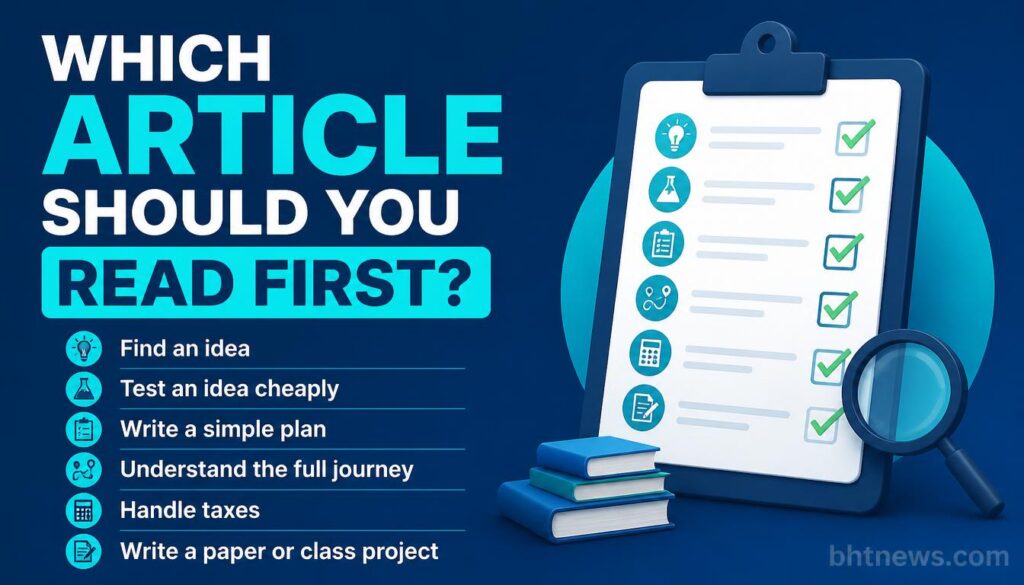
| If you want to… | Start with | Then read | Cost |
| Find an idea | How to Get Startup Ideas (Paul Graham) | The Lean Startup principles | Free-Free |
| Test an idea cheaply | Lean Startup principles (Eric Ries) | Do Things that Don’t Scale | Free-Free |
| Write a simple plan | SBA: Write your business plan | SBA: Calculate your startup costs | Free-Free |
| Understand the full journey | Startup Playbook (Sam Altman) | Why the Lean Start-Up Changes Everything (HBR) | Free-Paid |
| Handle taxes | IRS Self-Employed Individuals Tax Center | Your school’s student-business office | Free-Free |
| Write a paper or class project | Student Entrepreneurship in Universities (review) | Entrepreneurship education research (below) | Free-Free |
How I Picked These Reads
Each read met five criteria. Most ‘best’ lists never explain how they chose, so here is ours.
- Credibility: Written by a real expert, a well-known site, or published in a peer-reviewed journal.
- Free or flagged: You shouldn’t hit a paywall by surprise.
- Actionable: Teaches a skill students can actually use.
- Not just a trend: The advice holds up over time.
- I checked personally: I opened each article in October 2026 to see what’s there.
This is a curated list, not a ranking. No affiliate links, no paid placements.
A few famous startup articles didn’t make the cut simply because I couldn’t access them to check.
The 10 Best Entrepreneurship Articles For Students
You’ll find these in the order a student typically needs them: from ideas and testing to planning, money management, the bigger picture, taxes, and finally the research behind it all.
- How to Get Startup Ideas
Paul Graham, November 2012
Main idea: You don’t invent startup ideas; you spot real problems, ideally ones you have yourself. Live in the future and build what feels genuinely interesting.
Why read it? Because made-up ideas sound good but attract zero users. Narrow, urgent problems are gold.
Try it: List five daily annoyances at your school. Ask three friends which they’d pay to erase.
Limitation: Written mainly for technology startups, and it focuses on finding ideas rather than on whether a small business can scale. “Re-read the essay before keeping” ignores what actually matters if you’re not aiming for scale.
- The Lean Startup: Principles
Eric Ries, official Lean Startup site
Main idea: A startup’s real job is to discover what a sustainable business looks like. Build something small, measure how real people respond, then adjust or double down.
Why read it? Stops you from wasting months building what nobody wants.
Try it: Describe your idea in a sentence and design a one-week test (landing page, sign-up list, or pre-orders).
Limitation: Just the principles, not step-by-step. The real how-to is in Ries’s book.
- Why the Lean Start-Up Changes Everything
Steve Blank, Harvard Business Review, May 2013
Main idea: Old-school startups wrote business plans and raised capital without much customer feedback. Lean startups start with smaller tests, learn, and repeat.
Why read it: Explains the mindset shift: search for what works instead of betting big from day one.
Access notice: Only the intro is free unless you have library access.
Limitation: My summary is based on the public preview.
- Do Things that Don’t Scale
Paul Graham, July 2013
Main idea: When you’re new, hustle counts. Recruit users by hand, delight every customer, stay focused on a tiny market. Startups take off because their founders push them.
Why read it? Perfect if you’ve got time but not much money.
Try it: Recruit your first ten customers personally instead of doing a big launch.
Limitation: It’s for startups hoping to scale, and Graham’s advice reflects his view of early-stage startups and may not suit every business.
- Write Your Business Plan
U.S. Small Business Administration
Main idea: There’s no one right way to plan. Traditional plans are long and detailed, but a lean plan can fit on one page and takes less than an hour.
Why read it? Break down 9 core pieces of a lean plan all you need to get started.
Try it: Fill out those 9 boxes for your idea, and flag three assumptions you really need to check.
Note: It’s U.S.-focused, and lenders sometimes want more detail.
- Calculate Your Startup Costs
U.S. Small Business Administration
Main idea: Separate one-time from monthly expenses. Break-even means costs = income. Add 10% for “stuff happens.”
Why read it? Helps you budget and figure out if your idea is worth it.
Try it: Use your real numbers for a break-even estimate on something simple, like tutoring or campus services.
Limitation: Break-even is a rough guide, not an accounting rule.
- Startup Playbook
Sam Altman (Y Combinator), illustrated by Gregory Koberger
Main idea: You need a killer idea, good team, strong product, and legit hustle. Focus on delighting your first users before chasing big growth.
Why read it: A clear, start-to-finish guide, including how to choose your team.
Try it: Read the “idea” and “team” sections before teaming up with a friend.
Limitation: Geared toward classic tech-startups; some advice (like fundraising or ignoring competitors) isn’t for everyone.
- Self-Employed Individuals Tax Center
U.S. Internal Revenue Service
Main idea: If your net earnings from self-employment are $400 or more, you generally owe self-employment tax and must file a return. You may also need to make estimated tax payments if you expect to owe $1,000 or more.
Why read it? Even a small side gig comes with legal responsibilities.
Try it: Track every dollar earned and spent; ask your campus office how this affects your financial aid.
Limitation: Only covers U.S. rules, and not all deadlines are listed; read the forms.
- Entrepreneurship Education Research: Two Key Reads
a) Sun, Shi & Zhang, Frontiers in Psychology (2023)
b) Bae, Qian, Miao & Fiet (2014) summary by Shanshan Qian
Main idea: These studies find that entrepreneurship education is linked to entrepreneurial intention. Bae et al. found a small overall link, but it was not significant once students’ intentions before the course were taken into account.
Why read it? Reality check for what entrepreneurship education can and can’t do.
Try it: Use these if you write a paper or debate the value of these courses.
Limitation: The studies survey Chinese students (in Sun et al.), and the Bae et al. summary is not the full study.
- Student Entrepreneurship in Universities: State-of-the-Art
Schimperna, Nappo & Marsigalia, Administrative Sciences (2022)
Main idea: A literature review that organizes the research on student entrepreneurship, university support, and learning.
Why read it? A map to research if you’re picking a thesis or class topic.
Try it: Scan the abstract and follow footnotes that match your interests.
Limitation: Focused on business research; doesn’t spell out every research gap.
How to Turn Articles Into Action
Reading is only half the job if you don’t use what you learn.
Here’s a dead-simple loop for action:
- Read one article. Write down the single best idea you find.
- Turn it into a test (like “Ask 5 classmates by Friday”).
- Track what happens, especially what bombs.
- Compare “expert opinion” (like Graham’s essays) with real research (like Sun et al.).
How to Start a Business As a Student
Standard disclaimer: This is general advice; laws vary; always double-check with your school or a professional.
To get started: Validate a simple idea with real customers. Keep costs down, track every dollar, and check your school’s rules.
Here’s a simple cheat-sheet:
- Tackle a problem that bugs you and your friends.
- Talk to potential customers before building anything.
- Run a tiny test: a presale, a sign-up page, or a pilot service.
- Write a one-page business plan (see reads 5 & 6).
- Check school policies on campus businesses or intellectual property.
- If you make money, open a separate account and track it from day one.
- Understand your tax obligations (see read 8) before you start getting paid.
What if you’re an international student?
Visa rules can be strict. For example, U.S. rules on employment for F-1 students are strict, and they can apply to self-employment and paid freelance work. Rules differ for other visa categories and for work authorization such as OPT. Talk to your school’s international student office (your designated school official) before you start any business activity. Always check with your school’s international office first (and a legal expert if possible).
Low-Cost Business Ideas For Students
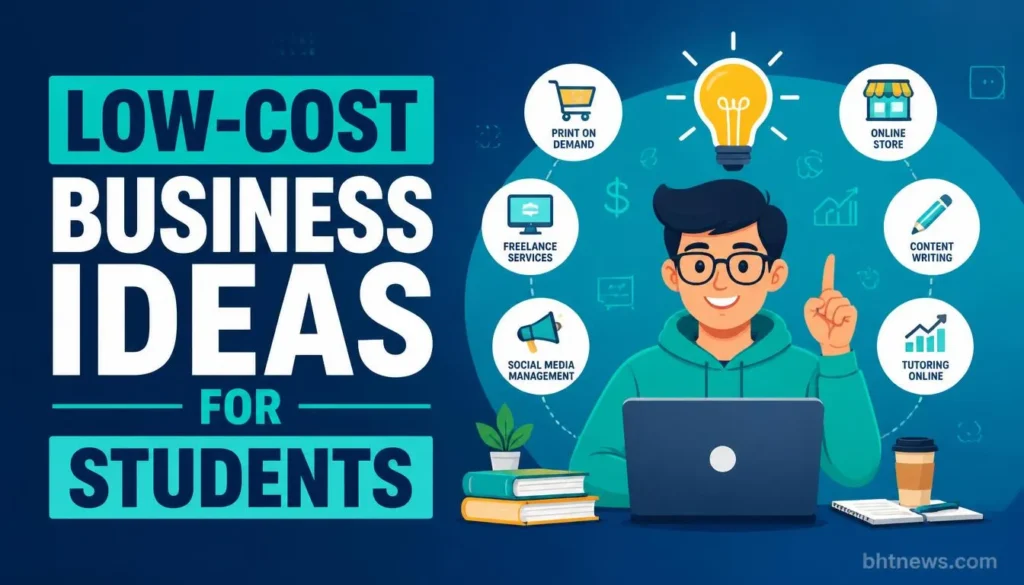
Most low-budget ideas revolve around skills or time; think tutoring, freelance work, reselling, or campus services. These aren’t get-rich-quick options, so treat wild income claims with skepticism. Always estimate your own costs and run a small test before betting big. Remember, platform fees and taxes eat into what you make.
| Idea | What you usually need to start | Main risk to check |
| Tutoring | Subject knowledge, a way to take bookings and payment | Competition, school rules on selling services |
| Freelance writing, design or coding | A portfolio and a freelancing profile | Platform fees, taxes, irregular income |
| Reselling used goods | Starter stock and a listing account | Sourcing costs, shipping, returns |
| Campus services (moving help, laundry, errands) | Time, a simple booking method | School policy, liability |
| Pet sitting or house sitting | References, a way to handle payment | Liability and local rules |
| Content creation | Phone, free editing tools, time | Slow income; platform terms |
Project Ideas for Classes and Clubs
The best projects connect with real people, not just theory. Some examples:
- Customer discovery: Interview 15-20 people on a campus problem and write up trends.
- Lean plan challenge: Complete the SBA’s one-page business plan for a business you could actually start.
- Micro-business pilot: Test a tiny business for a month. Report profit, surprises, and next steps.
- Competitor analysis: Compare three local brands on price, service, and reviews.
- Pitch competition: The Hult Prize runs a major student startup contest; check their rules.
- Teach a peer: Summarize one article and run the experiment together.
Topics for Talks, Essays, or Research
Some favorite topics:
- How to find a real (not fake) problem to solve
- Lean business plans vs. traditional
- Building a basic product, then pivoting
- Pricing basics and what makes a business break even
- Talking to customers
- Startup ethics
- Taxes and legal basics for young founders
- How to fund your first venture
- Failure: what you actually learn
Looking for a research angle? The 2022 Administrative Sciences review groups ideas into three fields: intentions, university support, and learning.
Here are a few questions to start with:
- Who on your campus is most likely to become a founder, and why?
- Does being in an incubator or a startup competition really change your path after graduation?
- What new skills do students gain from entrepreneurship classes, and how do they compare to those who never take them?
- How do rules like campus policies or visa limits shape what students even try?
Start with read 10, then dig through Google Scholar or your library for more. Always check the sample size and how recent the study is.
Student Founder Examples: A Word of Caution
Student success stories can be inspiring, but keep in mind: you only hear about the winners.
Google’s official story starts with Larry Page and Sergey Brin at Stanford, before going global after Andy Bechtolsheim’s early investment.
You’ll see names like Facebook, Dell, Snapchat, or Insomnia Cookies a lot too, but I couldn’t verify their stories directly from their corporate pages.
For legit, up-to-date examples, check your university’s entrepreneurship center to see which student founders are building something right now.
What the Evidence Says About Entrepreneurship Education
Research suggests taking entrepreneurship classes slightly increases the intention to start a business, but it’s not a magic bullet. For example:
- A 2014 meta-analysis of 73 studies (37,285 people) found a significant but small correlation between entrepreneurship education and intentions. After controlling for intentions before the class, the relationship was not significant.
- Sun, Shi & Zhang surveyed more than 92,000 students in China and found education made a difference, but mindset mattered even more (and their study can’t prove cause and effect).
Bottom line: In these studies, intentions before the course mattered most. We did not find a study here that compares classes with hands-on practice, so treat that comparison as unproven. Other claimed benefits like “better communication skills” are possible, but I didn’t spot hard evidence for those in the sources reviewed.
Conclusion
The best entrepreneurship reads don’t just fill your head; they get you moving. So pick any of the ten above, turn its top lesson into a mini-experiment this week, and actually track what happens. There’s no shortcut, just good questions, quick tests, and learning as you go.
Frequently Asked Questions
Which article should a beginner start with?
Paul Graham’s “How to Get Startup Ideas” is your first stop if you’re searching for an idea. If you already have one, the Lean Startup principles are next.
Do students owe taxes on side gigs?
In the U.S., yes, once you net $400 or more from self-employment, you have to file. Other countries vary, so ask someone who knows.
Can international students start a business?
Only if your visa allows it. At many U.S. schools, F-1 students can plan and research but not launch or take money without authorization. Always check with your school’s international office.
Do I need a business plan?
Not a massive one. The SBA says there’s no right or wrong way; a one-page version often works.
Do I need an LLC as a student?
Sometimes, but not always. A sole proprietorship is simple but riskier. An LLC costs more and creates a separate legal entity. Ask a pro about your situation.
Is entrepreneurship education worth it?
The studies cited here find a small link to intentions that mostly reflects intentions students already had. Mix classes with real-world tests if you want to learn the hard stuff.
Where do I find research topics?
Start with big literature reviews like the 2022 Administrative Sciences paper, then branch into Google Scholar or your library’s database.