









When conducting a Multichannel Ecommerce Software Comparison, the right tool depends mostly on monthly order volume and how much warehouse work you do.
Sellers under about 30 orders a month can start free with Sellbrite’s Free plan. Veeqo’s Shipping plan is free too, but it covers shipping only; stock sync starts at $19 a month. Growing sellers usually land between $19 and $600 a month.
Sellers with complex warehouses or high volume move to $1,000-plus platforms or quote-only systems. Prices below come from each vendor’s own page in November 2026.
Selling on your own store, Amazon and Walmart at once sounds like three times the sales. In practice, it often means three times the spreadsheets, until a product sells on one channel while it’s already out of stock on another.
Multichannel ecommerce software exists to prevent that: it connects your channels to one inventory count and one order queue.
This multichannel ecommerce software comparison looks at ten products across four types, with the pricing tiers each vendor shows publicly, the limits on those tiers, and the costs that rarely show up on a pricing page.
It doesn’t pick a winner, since a seller with 80 monthly orders and someone handling 8,000 shouldn’t shop for the same software.
Table of Contents
Quick Comparison: Who Each Tool Suits
| Business Stage | Tools to Look at First | Why |
| Just starting, a few dozen orders a month | Sellbrite (Free), Veeqo (Inventory, from $19), Katana (Free) | Free or near-free plans exist, with caps on orders or SKUs. Veeqo’s free plan is shipping-only. |
| Growing, a few hundred to a few thousand orders a month | Sellbrite Pro, Veeqo Inventory, Cin7 Core Standard or Pro | Published prices from $19 to $599 a month, scaled by orders. |
| Storefront is the hub | Shopify, BigCommerce | Selling tools are built in, but channel and warehouse depth is lighter than dedicated tools. |
| Marketplace-heavy or warehouse-heavy | Zentail, Sellercloud, Cin7 Advanced | Higher base prices, more automation and warehouse features. |
| Complex, high volume, or multi-region | Linnworks, Brightpearl | Quote-only. Expect a sales process and an onboarding project. |
What Does Multichannel Ecommerce Software Actually Do?
It handles four main jobs:
- Syncs inventory. When you sell an item on one channel, your stock drops everywhere.
- Unifies orders. It pulls every order from every channel into one list.
- Updates listings. It pushes product listing changes across the marketplaces.
- Sends tracking back. Each channel marks orders as shipped.
Basically, it handles four main jobs.
- First, it syncs inventory when you sell an item on one channel; your stock drops everywhere.
- Next, it pulls every order from every channel into one unified list. It updates your product listings across the marketplaces.
- Finally, it sends back tracking numbers so each channel marks orders as shipped.
Past that, tools diverge. Some add warehouse features such as barcode scanning and pick paths. Some add purchasing and demand forecasting.
A few add accounting links or a full back-office. That spread is why comparisons get confusing, and why this article groups tools by type:
- Listing and inventory sync tools (like Sellbrite, Veeqo, Zentail) focus on connecting sales channels, managing product listings, and tracking stock.
- Inventory and order platforms (Cin7, Sellercloud, Linnworks, Katana) offer deeper control like purchasing and warehouse management.
- Retail operations systems (Brightpearl) pull together inventory, orders, accounting, and customer data into one tailored system.
- Storefront platforms (Shopify, BigCommerce) are all about your online store first, then layer on marketplace integration.
How this Comparison Was Made
Each vendor’s pricing page was opened in November 2026, and plan names, prices, order limits, and stated features were taken from what the page displayed. Where a page showed no price, this article says so rather than estimating one.
Nothing here is a hands-on test: no accounts were opened, and no sync speeds were measured. Feature claims reflect what vendors say about themselves.
A few pages didn’t load or gave incomplete information, and those gaps are listed in the Sources section at the end.
ChannelEngine, Rithum, Extensiv, and ShipStation pages could not be read, so they’re not priced here.
Ecomdash’s page now announces that the product is becoming Network Solutions, so it’s left out too. No money changed hands for any placement, and there are no affiliate links.
Pricing Tiers Compared
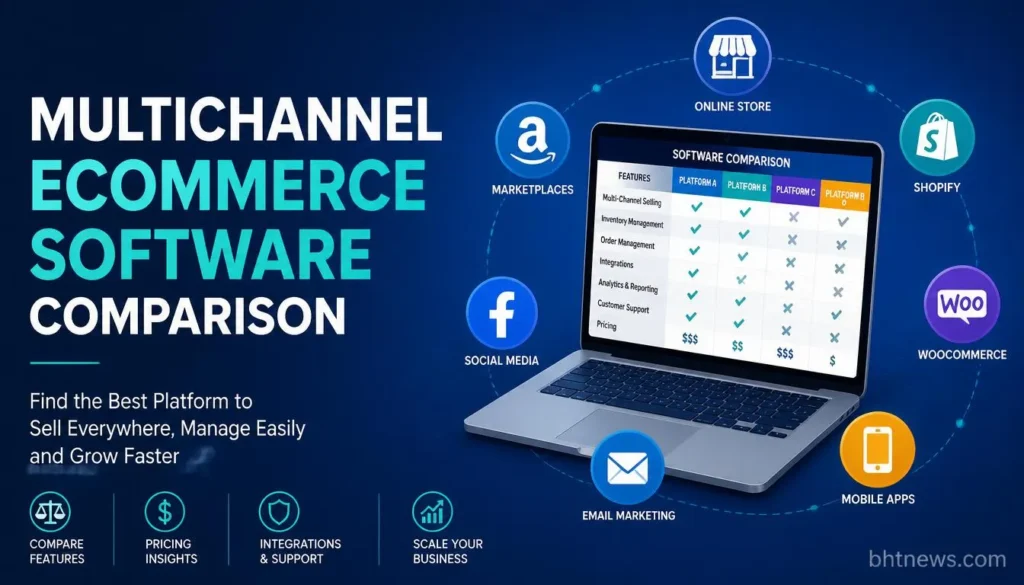
Prices are USD, as displayed in November 2026. “Annual billing” means the lower rate shown when you commit for a year. Confirm current numbers on the vendor’s page before deciding.
| Tool | Published Tiers | Main Limit | Catch |
| Veeqo | Shipping: free (shipping only). Inventory: from $19/mo. High Volume: from $350/mo. | Paid plans are priced by monthly order volume; tiers not listed on the page. | The free plan is funded by commission on shipping labels bought through Veeqo. Stock sync starts on the Inventory plan. |
| Sellbrite | Free (30 orders/mo); Pro 100: $29; Pro 500: $79; Pro 2K: $179 (annual billing) | Orders per month. Channels, SKUs, and users are unlimited. | Free plan syncs every 2 hours, paid every 15 minutes. FBA add-on is $19/mo. Trial length is stated as 14 days in the body and 30 in the page title. Passing your cap mid-cycle moves you up a tier, prorated. |
| Katana | Free (30 SKUs, Shopify only); Advantage: custom, annual contract | SKU cap on Free after a 15-day open trial. | No live support on Free (AI assistant and knowledge base only). |
| Cin7 Core | Standard: $349/mo; Pro: $599/mo; Advanced: $1,199/mo | Annual sale orders: 6,000, 24,000, 120,000. Integrations: 2, 4, 6. | Omni is quote-only. Many modules (POS, B2B portal, extra integrations) are add-ons with no listed price. |
| Zentail | Base: from $300/mo; Pro: from $2,000/mo; Enterprise: by annual sales | Priced on annual revenue across all channels. | Most plans are annual contracts. Walmart self-serve on Base is month-to-month: $300/mo platform fee plus $0.10 per active listing and $0.50 per order. |
| Sellercloud | Essentials: from $1,349/mo; Growth: from $1,849/mo; Enterprise: custom | Final price depends on order volume, fulfillment mix, and add-ons. | Page and FAQ disagree on whether the warehouse module is included in Growth. Ask for it in writing. |
| Linnworks | Quote-only | Tiered by monthly orders, with overages. | Onboarding is a separate one-off fee. |
| Brightpearl | Quote-only | Bespoke scope; unlimited users stated. | Pricing follows a consultation and demo. |
| Shopify | Basic 39/mo(29 annual); Grow 105(79); Advanced 399(299); Plus from $2,300/mo (term commitment) | Staff accounts, card rates and fees vary by plan. | Third-party payment gateway fee: 2%, 1%, 0.6%, 0.2% by plan. Over 50 synced marketplace orders a month cost 1%, up to $99/mo. |
| BigCommerce | Core 39/mo(29 annual); Growth 105(79); Scale 399(299); Performance from $1,499/mo | Page shows annual-sales bands per plan; Core up to $30K, Growth up to $100K; Scale about $33,333 a month, with a 0.9% overage. | Multi-storefront is a paid add-on ($30 to $100/mo by plan). Performance is aimed at $1M-plus in annual sales. |
Free and Entry-Level Tiers: $300 to About $180 a Month
This is where most new multichannel sellers should begin, and where the biggest differences hide in the limits, not the prices.
- Veeqo
- Veeqo’s Shipping plan is free with unlimited orders, users and SKUs, according to its page. It’s built for shipping, though: stock sync, demand forecasting and unlimited listings arrive with the Inventory plan.
- The catch is the business model: Veeqo says it earns a commission on labels bought through it. If you already use Veeqo’s carrier rates, the plan costs you nothing extra.
- If you ship through a negotiated carrier account elsewhere, check what you’d lose. The Inventory plan, from $19 a month, adds automated stock sync and unlimited multichannel listings.
- Its exact price rises with the monthly order volume you select, and those steps aren’t published. Amazon FBA orders are excluded from that chargeable volume.
- Sellbrite
- Sellbrite prices by order count and nothing else: unlimited channels, SKUs, and users on every plan. That makes it easy to forecast.
- A seller shipping 400 orders a month would land on Pro 500 at $79.
- Two things to note: Amazon FBA orders don’t count toward the cap on paid plans, and the Free plan only syncs every two hours, which matters if you sell fast-moving stock on several channels.
- If you pass your cap mid-cycle, you move up a tier automatically and pay a prorated amount.
- Katana
- Katana’s free plan includes unlimited users, integrations, and API access, but caps you at 30 SKUs after the first 15 days and works with Shopify only.
- Support is limited to an AI assistant and a knowledge base. It’s a way to test the product, not to run a large catalog.
- The paid Advantage plan is custom-priced and sold on an annual contract.
Mid-Range Inventory Platforms: Roughly $350 to $2,000 a Month
- Cin7 Core
- Cin7 Core is one of the few in this group that publishes three clear tiers.
- Upgrading from Standard ($349) to Pro ($599) gets you more users (jumping from 5 to 10), more annual orders (from 6,000 to 24,000), and two extra integrations.
- Note that the limit is per year. Standard is good for about 500 monthly orders on average.
- Seasonal sellers should check how a November spike counts against the annual total.
- Zentail
- Zentail prices on annual revenue across every connected channel, so adding a channel doesn’t raise the bill by itself.
- Base starts at $300 a month and Pro at $2,000.
- There’s also a Walmart self-serve option listed for the Base plan, month-to-month, with a $300 platform fee (first month waived), plus $0.10 for each active listing and $0.50 per order.
- That usage-based part can work for a small Walmart catalog, but the flat fee sets the floor, so run the numbers both ways.
- Sellercloud
- Sellercloud’s page is clear on structure: a subscription priced on order volume, with unlimited users, and Essentials from $1,349 and Growth from $1,849 a month.
- Implementation typically takes six to eight weeks and is generally included.
- It has the highest published entry price in this group, so it suits sellers whose operations already justify it.
- Linnworks
- Linnworks is a global omnichannel inventory and order management software platform for small-to-medium businesses and growing e-commerce retailers.
- Multichannel Synchronization: This ties together inventory, orders, listings, and shipping across more than 100 marketplaces (Amazon, eBay, Shopify, Walmart, TikTok Shop, and more) so you don’t oversell.
- Order & Rules Engine: Automates order routing, picks carriers, prints labels, and does all this with customizable rules.
- Warehouse Management (WMS): Comes with a built-in WMS and SkuVault Core integration for picking, packing, and quality checks.
- Spotlight AI: Flags bottlenecks, then recommends automations to cut down on manual grunt work.
- Stock Forecasting: Calculates how much you need to restock, looking at sales history, velocity, seasons, and supplier lead times.
- BrughtPearl
- Brightpearl is a cloud-based Retail Operating System (ROS) built for multichannel e-commerce merchants, DTC brands, and wholesalers (usually doing $1M+ a year).
- It’s bigger than simple inventory apps or bulky ERP systems; Brightpearl brings back-office workflows together.
- Who’s it for? Established brands who’ve outgrown patchwork solutions and want a clear, centralized backbone.
- Automation Engine: Handles everything from order-to-cash, fulfillment, multi-location stock routing, and shipping. Cuts manual work, reducing errors by around 65%.
- Inventory Management & Planning: Shows real-time stock levels across warehouses, stores, and online channels. Has built-in demand planning, sales forecasting, and buying smart suggestions.
- Integrated Accounting: Tracks double-entry bookkeeping, keeps the general ledger updated, manages accounts receivable/payable, multi-currency processing, and generates full financial reports.
- Multichannel Integrations: Plug-and-play connectors for Shopify, Amazon, TikTok, and Instagram sync stock, pricing, and orders almost instantly.
- Retail Analytics & BI: Gives you KPIs, margin insights, channel performance, and industry benchmarks.
- Shopify
- Shopify’s an all-in-one cloud commerce platform. You can build a store online, sell in person, and handle inventory, payments, and shipping all from one dashboard.
- No-Code Store Builder: Build your storefront with drag-and-drop tools, mobile layouts, and ready-made themes.
- Sidekick AI Assistant: Use AI to build themes, write product descriptions, and set up your store.
- Unified Checkout & Payments: Accept credit cards, wallets, and crypto all through Shopify Payments or over 100 other gateways. Shop Pay speeds up checkout.
- Omnichannel & Global Selling: Sell anywhere- web, socials, POS, or international via Shopify Markets.
- App Ecosystem: Expand with thousands of apps for marketing, dropshipping, print-on-demand, SEO, and more.
- Built-In Operations: Track orders, tax automatically, get shipping rates, and access business analytics.
- BigCommerce
- BigCommerce is a cloud-based SaaS platform where businesses launch and grow online stores.
- Open Architecture: Handles B2C, B2B, and hybrids, letting you access APIs and dig into the code.
- No Transaction Fees: You can use third-party payment gateways without extra fees, unlike a lot of competitors.
- Omnichannel Selling: Sync products across Amazon, eBay, TikTok, Meta, and more through Feedonomics Surface.
- B2B Features: Offers pricing by account, company hierarchies, and self-service reorder options.
- Built-in Tools: Native SEO, drag-and-drop pages, AI catalog enrichment.
- Pricing & Plans: Standard, Plus, Pro, Enterprise. Standard starts at $29/month.
- You have to upgrade as your annual sales grow. There’s a free 15-day trial with everything unlocked.
Storefront-Led Options: Shopify and BigCommerce
- If your main channel is your online store, you might not need extra tools at first. Shopify and BigCommerce both start at $39 a month ($29 if billed annually) and go up to $399 ($299 a year) before the premium tiers. Shopify Plus starts at $2,300 a month and BigCommerce Performance at $1,499.
- BigCommerce says Amazon, eBay, and Walmart integrations come standard, and that Google, Meta, TikTok, Microsoft, and Pinterest run through its Feedonomics Surface add-on. Its plans carry online-sales limits, so a fast-growing store can outgrow Core (30K) or Growth (100K) sooner than expected. Confirm its SKU limits on its page.
- Shopify’s page mentions marketplace selling without naming channels: 50 synced marketplace orders a month are free, and orders above that cost 1%, up to $99 a month. Check its app store for the channel you need.
Quote-Only Platforms: Linnworks and Brightpearl
- Neither vendor publishes a price. Linnworks prices by monthly order volume, with overages and a one-time onboarding fee based on your setup. Its page doesn’t mention percentage fees. It says it connects 100-plus channels and includes a warehouse module, rules-based order routing, and stock forecasting.
- Brightpearl calls itself a retail operating system, with inventory, order management, accounting, and analytics in one platform. It says it builds a custom setup for each client, with unlimited users, a customer success manager, and a written price breakdown before you sign. It’s aimed at established brands that have outgrown simpler tools.
- If a competitor article quotes a firm price for either, ask where it came from. Third-party estimates for quote-only vendors are guesses, and this article doesn’t offer one. Ask both vendors for a written quote against your own order volume, channel list, and warehouse setup.
What the Pricing Page Doesn’t Show
- Order-Cap Rules. Check whether the cap is monthly or annual, and what happens when you exceed it. Cin7’s is annual; Linnworks charges overages; Sellbrite moves you up a tier, prorated.
- Add-ons. Sellbrite’s FBA module is $19 a month per paid plan. Cin7 lists POS, a B2B portal, and extra integrations as add-ons without prices. Sellercloud’s warehouse module has been quoted as $500 to $650 a month in its FAQ.
- Onboarding. Linnworks charges a separate onboarding fee. Sellercloud generally includes implementation. Ask for a fixed number.
- Contract length. Zentail’s plans are mostly annual. Katana’s Advantage plan is an annual contract too. Month-to-month is the exception.
- Marketplace fees. Software fees don’t cover Amazon, Walmart, or eBay’s own seller fees, shipping costs, or payment processing. Those come on top.
- Your own time. Product data cleanup, channel mapping, and testing take real hours. Budget for them before you switch.
Three Illustrative Cost Scenarios
These are hypothetical, built only from the published prices above. They show how the math works, not what any real business would pay.
- A 120-order-a-month seller on Shopify and Amazon. Sellbrite Pro 500 at $79 a month (annual billing) would cover it, with room to grow. Add the $19 FBA module if FBA stock needs syncing: about $98 a month in software. Veeqo’s free Shipping plan could cover labels at no cost, but it doesn’t sync stock, so you’d need the Inventory plan (from $19 a month) for that.
- A seller processing 2,000 monthly orders across three marketplaces will hit 24,000 a year, right at Cin7 Core Pro’s $599 ceiling. If you’re busy in Q4, Advanced at $1,199 is probably safer. Sellbrite Pro 2K at $179 also covers 2,000 monthly orders, so check the features, don’t just look at price.
- For sellers handling 5,000 monthly orders with a warehouse, that’s 60,000 annually. Cin7 Pro won’t cut it, but Advanced at $1,199 fits the bill. Sellercloud Essentials starts at $1,349, and Linnworks or Brightpearl should be on your shortlist, plus any warehouse add-ons.
How to Choose: A Short Checklist For Demos
Before you hop on a demo, jot down five things: your monthly order count (with your busiest month), active SKUs, channels now and in the next 12 months, warehouse locations, and the number of staff handling orders.
Then ask each vendor:
- What is my price at these exact numbers, in writing, including add-ons?
- How often does inventory sync, and what happens when a sync fails?
- Which channels do you connect natively, and which need a third-party app?
- What is the contract length, and what are the exit terms?
- How long does onboarding take, and what does it cost?
- Can I export all my data if I leave?
If a vendor won’t answer the first question in writing, treat that as information.
Conclusion
A multichannel ecommerce software comparison is only useful if it starts from your numbers. Orders per month and your peak month decide most of the price, and the warehouse question decides most of the rest. Free and low-cost tools can cover small volumes; the expensive platforms justify their price when stock, purchasing, and multiple locations become the real problem.
Next step: write down your monthly orders, SKUs, and channels, then ask two vendors of different types for written quotes at those numbers. Compare them side by side before you book a third demo.
Disclosure: this article is general information, not a recommendation for your business. Prices and plan terms were read from vendor pages in November 2026 and can change. Verify on the vendor’s page before you buy. bhtnews.com has no affiliate relationship with the vendors named here.
Frequently Asked Questions
Is there free multichannel ecommerce software?
Yes, with limits. Sellbrite’s Free plan covers up to 30 orders a month, Katana’s free plan covers 30 SKUs on Shopify, and Veeqo’s Shipping plan is free with unlimited orders but covers shipping only. Veeqo funds its free plan through commission on shipping labels, so check how that affects you.
How much does multichannel ecommerce software cost?
Published entry prices run from $0 to about $180 a month for listing-focused tools, from $300 for Zentail, $349 to $1,199 for Cin7 Core, and $1,349 or more for Sellercloud. Linnworks and Brightpearl are quote-only. Add-ons, onboarding, and overages can raise the real figure.
Do I need this software if I only sell on Shopify and one marketplace?
Possibly not. A low order volume can be handled by a free tool or by hand, and BigCommerce’s page lists Amazon, eBay, and Walmart connections on its plans. The point where software pays off is usually when overselling or manual updates start costing sales or hours.
Is multichannel software the same as inventory management software?
No, though they overlap. Inventory software tracks stock and purchasing. Multichannel software adds channel connections, listing management, and order routing. Some products, such as Cin7 and Sellercloud, do both.
What is the difference between per-order and revenue-based pricing?
Per-order pricing (Sellbrite, Sellercloud, Linnworks) charges by how many orders you process, so low-ticket, high-volume sellers pay more. Revenue-based pricing (Zentail) scales with sales, so high-ticket sellers pay more. Run both against your numbers.
How long does it take to switch to a new system?
It depends on the tool. Sellercloud states six to eight weeks for implementation. Listing tools can be set up much faster, but cleaning product data is usually the slow part. Ask each vendor for a timeline in writing.