











you want the best digital marketing agency in Australia for 2026? The “best” agency isn’t always the flashiest. It’s the one that matches your goals, your budget, and actually lets you own your accounts, understand the reports, and walk away if you need to—without a penalty.
Australians running small to mid-sized businesses generally pay anywhere between $2,000 and $10,000 a month in agency fees. Add your ad spend and 10% GST to that. Choosing the right agency isn’t something you want to do on instinct—have a checklist, not just a gut feeling.
In short:
- Budget: Expect around 2,000–6,000 per month for a bundle of SEO and ads. If you’re aiming higher—big campaigns, complex strategies—think more like 3,500–10,000 each month, plus ad spend and GST.
- Must-haves: You should own all your accounts and analytics. Reports should actually tell you about leads and revenue, not just “clicks.” And the contract? No traps—fair exit terms only.
- Watch out for: Promises of “guaranteed” rankings, ironclad long contracts with exit fees, wishy-washy reports, and agencies that won’t say who’s actually doing your work.
- Timelines: Expect to really judge paid ads after two to three months. With SEO, give it three to six.
Table of Contents
What Does a Digital Marketing Agency in Australia Actually Do?
A digital marketing agency basically handles your online marketing—usually across SEO, paid ads (like Google and social media ads), content, email, you name it. Some focus on one area (say, just SEO or just ads), others cover a bit of everything.
| Agency Type | What They Do Best | Typical Fit |
| Specialist (SEO or PPC only) | Great skill in one channel | Businesses that already know their main channel |
| Boutique full-service | A few channels with senior attention | Small businesses wanting a named contact |
| Mid-tier agency | Multiple channels plus creative and analytics | Growing businesses with several goals |
| Enterprise agency | Large teams and complex, multi-market programs | Big brands and national campaigns |
| Fixed-price platform | Packaged services at a set monthly price | Startups and very small budgets |
There are thousands of agencies in Sydney, Melbourne, Brisbane, and Perth alone—and their quality is all over the place. That’s exactly why you need to vet them properly.
How Much Does a Digital Marketing Agency Cost in Australia in 2026?

You’ll hear all sorts of numbers, but here’s the reality: boutique specialists might start at $1,500 a month, while some enterprise teams charge $20,000 or more. Most small and mid-sized businesses fall into that 2,000–10,000 range.
| Source (2026 guide) | Range Reported | What It Describes |
| Precision Digital | 2,000–6,000/mo | Combined SEO, some paid ads, monthly reporting |
| WME | 3,500–10,000/mo | Meaningful SMB campaign with depth; $800 to $80,000+ overall |
| Thinkify | 1,500–3,000 boutique; 3,000–7,500 small; 7,500–20,000 mid-tier; $20,000+ enterprise | Management retainer only, ad spend excluded |
| Workspace | 2,000–15,000+/mo | Agency retainers; fixed-price platforms from $399/mo |
Keep in mind, the guides you see online are usually written by agencies trying to set expectations.
They’re useful for spotting what’s normal and what’s an outlier, but always ask for itemised quotes.
Typical costs:
- SEO retainer: About 1,500–5,000/month, with real results showing up after three to six months.
- Google Ads management: 800–2,500/month (plus you pay Google for ads).
- Hourly rates: 120–250/hour (more for senior strategists).
- Website builds: Varies wildly, from $3,000 up to $20,000+.
How Agencies Charge:
- Flat monthly retainer for a set list of tasks.
- Retainer plus whatever you pay directly for ads.
- Percentage of ad spend (e.g., 40–80% of spend at low budgets, dropping to 10–20% as budgets grow).
- Pay-for-performance, sometimes combined with a retainer and bonus structure.
Work Out the Fully Loaded Monthly Cost
And remember—retainers are just the start. Ask every agency for a “fully loaded” monthly cost: retainer + ad spend + creative + landing pages + tools + GST. A lot of agencies quote without GST, so double-check.
Agency, Freelancer, or In-House Marketer?
Go with an agency if you need lots of skills at once but aren’t ready for full-time hires. Freelancers work for narrow, tightly defined tasks on a squeeze-the-budget basis. In-house suits you when your marketing is non-stop and specific just to your brand. Ignore glossy pitches—your needs and budget call the shots.
| Option | Typical Cost | Strength | Watch Out For |
| Freelancer | About 1,000–2,500/mo | Low cost, direct contact | One person’s limits and availability |
| Agency | About 2,000–10,000+/mo | Range of skills and tools | Junior hand-offs, lock-ins |
| In-house hire | Specialist salary of 90,000–110,000; manager 110,000–150,000 | Full focus on your brand | Super (12%), payroll tax, recruitment cost |
Don’t forget extras on in-house hires: superannuation, payroll tax, recruitment fees. Always compare the true total cost, not just the base salary versus retainer price.
How Do You Pick the Best Digital Marketing Agency in Australia?

Don’t just Google “best agency” and sign whoever calls back fastest. Test every agency against these eight basics:
- Know what you want—leads, sales, brand awareness? Pick your goal, then set your monthly spending range. Different aims mean different kinds of agencies.
- Make them show you proof. Ask businesses of your size in your industry for case studies that spend about what you plan to spend. Look for real numbers: cost per lead, return on ad spend, actual results.
- Find out exactly who’s doing your work. Names, titles- are they in-house or offshore? Is the senior person in the sales call ghosting once you sign?
- Account ownership is a dealbreaker. Your Google Ads, Analytics, website, all of it—those are yours. The agency should just be a user. Ask straight: Do I keep everything if I leave?
- Reports should tie actions to leads, enquiries, or revenue. If all you see are report cards full of impressions and clicks, run.
- Scrutinise the contract. Minimum terms, cancellation fees, exit process—anything odd? Most confident agencies keep term lengths short and only ask for what makes sense.
- Get clear, itemised pricing. See where fees go, what’s included, what’s not, and make sure GST, ad spend, creative, and tools are in those figures.
- Ask about data and privacy. How do they store your customer’s details? How do they handle tracking consent? What’s their process if there’s a breach?
Google Partner or similar badges can be a useful signal, but one Australian agency guide notes that partner status is not a free pass. Treat badges as a starting point for questions, not proof of quality.
Key Questions To Ask Before Signing
Before you sign, ask every agency the same questions. Get their answers in writing. Vagueness and hesitation are red flags.
- Who’s working on my account, day-to-day?
- When I leave, do I own all my ad accounts, analytics, website files, and data?
- Case studies, please: show me campaigns with a cost per lead or ROAS from a business like mine.
- What’s the minimum contract length? What’s the exit cost?
- Exactly how is my fee set? How much will I actually pay, with GST, ad spend, and extras?
- What does a typical monthly report look like? Show me.
- Tell me about a campaign that didn’t work out—how did you handle it?
- What gets done in-house, and what gets sent offshore?
- How do you manage customer data and privacy consent?
- What kind of results should I expect after 30, 90, and 180 days?
That “tell me when things went wrong” question is gold. Good agencies are honest when something’s not working and will recommend a change, even if it means they make less.
Biggest Red Flags
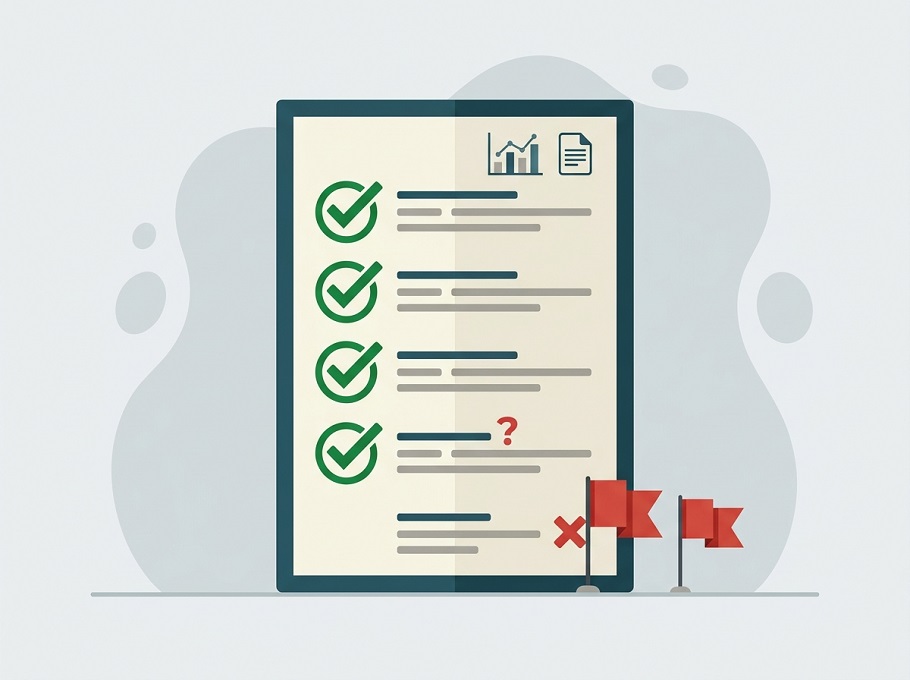
Be wary of agencies who guarantee results, push long contracts with heavy penalties, refuse to give you ownership of your accounts, or won’t let you see the raw data. If you spot more than one of these, it’s time to walk away.
| Red Flag | Why It Matters | Severity |
| Guaranteed #1 rankings or fixed results | Nobody controls Google’s algorithm; a guarantee means dishonesty or risky tactics | High |
| Refusal to give account ownership | Makes it hard to leave and can mean losing your campaign history and data | High |
| 12-month lock-in with penalties | Protects the agency, not you; confident agencies rarely need it | High |
| Vanity-metric reporting | Impressions and clicks don’t show leads or revenue | Medium–High |
| No named team | Signals a junior hand-off after the pitch | Medium |
| Suspiciously cheap (well under $1,000/mo management) | May not fund the senior hours needed to do the job properly | Medium |
| Uncapped percentage-of-spend fees | Rewards the agency for higher spend, whether or not it helps you | Medium; fine if capped and transparent |
| Generic discovery call | If the call could fit any industry, the agency isn’t studying your business | Low–Medium |
Percentage-of-spend pricing isn’t automatically bad, but it should have a cap or a clear reason behind it—otherwise the agency’s just rewarded for spending more of your money.
Privacy and Data Questions
- Privacy’s getting tighter. Ask how an agency collects, stores, and shares customer data.
- Australia’s Privacy Act got new reforms in late 2024, and as of October 2026, more changes are coming but not yet locked in.
- Key proposals include requiring more specific consent, handling geolocation as sensitive info, and reporting data breaches fast.
- This is all fluid, so get legal advice that’s right for your business.
- Bottom line: pick an agency that’s up front about consent, documents it, limits data collection, and alerts you quickly if there’s a breach.
How Long Until You See Results?
You should start seeing results from paid campaigns within 60 to 90 days. SEO is a longer game—expect real traction after three to six months and the full impacts within a year. Use these windows to assess progress, not to justify being locked in.
| Channel | When to Expect Signals | What to Check |
| Google Ads / paid social | 60–90 days | Cost per lead, conversion rate, return on ad spend |
| SEO | 3–6 months for movement; 9–12 months for full effect | Rankings for target terms, organic leads |
| Content and email | 3–6 months | Engagement, enquiries, list growth |
As a tip: in Google Ads, go digging in the Change History—that’s where you see what your agency’s really been doing.
Does Location Matter?
Not really. Most digital work can be done anywhere, so agencies don’t need to be down the street. But if local search, Google Business Profile, or lots of in-person meetings matter, a local agency helps. For national e-commerce brands, hire for skill, not proximity. Make sure you know their time zone and how quickly they’ll respond if they’re interstate or overseas.
- Pick a local agency if you rely on foot traffic, local service areas, or reviews.
- If you sell nationally online, focus on agency skill and fit over location.
Conclusion
Finding the best digital marketing agency in Australia means picking the one that fits your goals, gives you account ownership, reports on leads and revenue (not just activity), and lets you leave without a trapdoor contract. Don’t just compare retainers—look at the fully loaded monthly cost and ask exactly how data’s handled, especially as privacy law moves fast.
Numbers change, and privacy reforms are still proposals as of October 2026. Always confirm the latest info and get your own legal advice before signing.
Ready to get started? Make a shortlist of three agencies this week. Send each the same ten questions. Compare the answers side by side—before you take a single sales call. That’s how you choose smart.
Frequently Asked Questions
How much does a digital marketing agency cost in Australia?
Most small and mid-sized businesses in Australia pay somewhere between $2,000 and $10,000 a month for agency fees. Boutique specialists usually start around $1,500, while bigger enterprise teams can go over $20,000. Keep in mind, ad spend, creative work, tools, and 10% GST are usually extra. Always ask for the all-in monthly number so you don’t get surprised.
Is a 12-month contract normal for a digital marketing agency?
A year-long contract isn’t unusual, but you don’t have to sign one. Plenty of agencies work month-to-month or have short minimum terms. Actually, lots of Australian guides warn about contracts with exit penalties or long lock-ins. For SEO, a minimum of six months can make sense, as long as there are clear results and a fair way to exit.
Should I pay a percentage of my ad spend?
Sometimes it’s fair, depending on how much you’re spending, but you want a cap or good reason for the fee. If the percentage fee isn’t capped, agencies get rewarded for spending more of your money—which isn’t always great for you. Compare it to a flat retainer for the same scope of work.
Who should own the Google Ads and analytics accounts?
You should always own them. Make sure the accounts are set up in your business’s name and just add the agency as a user. That way, your history and data stay with you, even if you switch agencies. If an agency pushes back on this, you should definitely reconsider working with them.
How do I know if my agency is actually doing its job?
Don’t get distracted by clicks and impressions. Watch for actual movement in leads, cost per lead, and revenue. You should see results from paid campaigns within 60 to 90 days and from SEO work in three to six months. You can also check Google Ads Change History for proof they’ve done what they say.
Looking to build stronger domain authority? Get in touch with our team at editorbhtnews@gmail.com for curated off-page SEO services, featuring high-metric placement opportunities at competitive market rates.