



Finding the right small business coach for women is really about where you are in your business journey and what you can afford, not about anyone’s ranking or top list.
If you’re still figuring things out or watching your wallet, free mentoring from SCORE or free to low-cost counseling from SBA-supported Women’s Business Centers gives you hands-on help.
Paid coaches and programs come in all shapes and sizes, from self-paced courses to exclusive, invite-only coaching groups, and most do not publish their prices.
I put this guide together by looking at 15 options, double-checking each one on its own official page in October 2026.
You’ll see how they made the list, what they charge (if they tell you), who each one is best for, and what to watch out for before paying.
Here, six entries below are courses, specialists, or networks rather than coaches. We include them because they solve one problem; each is labeled. Like pricing, offers, marketing, systems, and growth, not generic life coaching or career advice.
A note on best: Don’t take best too seriously. This is a hand-picked shortlist, not a ranking. We can’t rank coaches we haven’t worked with. The order reflects type of support, not quality.
Table of Contents
Quick Picks: Who Should Try Which Option?
- Tight budget: SCORE mentoring (free), Women’s Business Centers (free or low-cost), local Small Business Development Center (SBDC).
- Want to learn at your own pace: Keep B-School here. Move Maya’s group program to a new line, “Want live group classes,” because your own profile says it is live.
- Prefer one-to-one help: Maya Elious private coaching ($5,000 for 90 days), Amy Porterfield’s Calibrae Collective (price not shown), Rosetta Thurman (free intro session; coaching programs not described on her page).
- Need community: Female Entrepreneur Association (waitlist only), Ellevate (peer mentoring).
- Facing a specific block: money mindset (Denise Duffield-Thomas, Kate Northrup), publicity (Selena Soo), email writing (Laura Belgray).
How I Built This List
Every option had to meet four criteria. Most lists never explain how they chose, so here is ours.
- It had to be relevant: The coach or program serves small business owners, or the program is a widely available public resource open to women
- It had to be verifiable: I checked the provider’s official page myself in October 2026. If I couldn’t get to the page or read it, I skipped it.
- Transparency: I noted price, format, and enrollment status exactly as shown; if prices weren’t listed, I said so.
- Variety: You’ll see a mix of free programs, one-on-one coaching, group options, and specialists so you can compare cost and style.
You should know: I didn’t test these programs myself or dig up real client stories or third-party results.
Any numbers like “80,000 graduates” or “40,000 women helped” are straight from the providers. No affiliate links, no paid placements. None of the links here are affiliate links, and no provider paid to be included.
A few big names like Tara McMullin’s CoCommercial, Ali Brown’s Ali International, and Hannah Roper’s The Female Creative aren’t here simply because I couldn’t read their pages during my research. That’s about access, not quality.
All 15 Coaches and Programs at a Glance
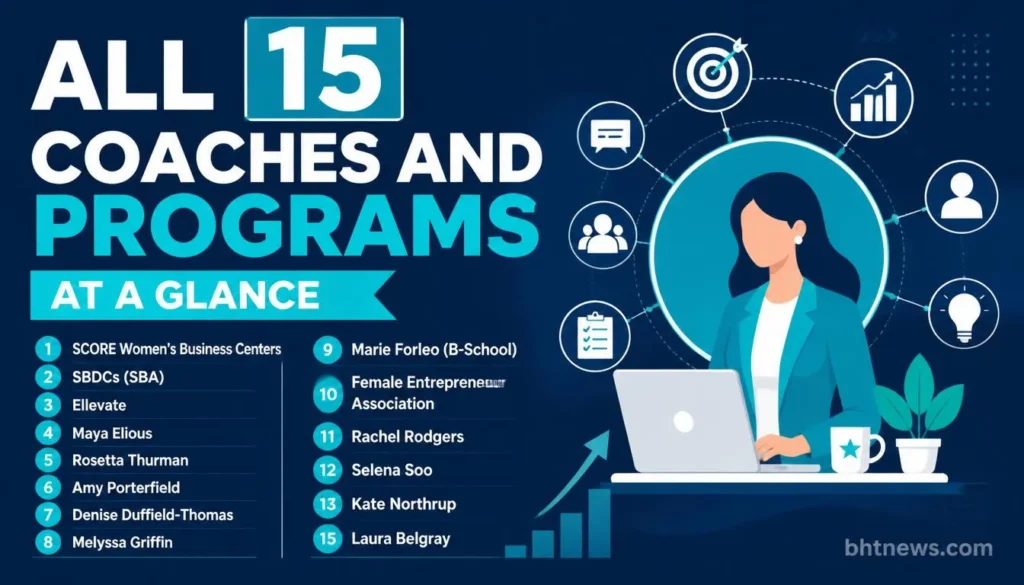
Prices appear only where the provider’s page listed one; otherwise the cell says Not shown. Always ask about costs before committing.
| Option | Type | Best for | Format | Price on page (Oct 2026) |
| SCORE | Free public mentoring | Any stage, US-based owners | 1:1, virtual or in person | Free |
| Women’s Business Centers (SBA) | Public program | Women starting or growing | Counseling and training | Free to low-cost (per SBA) |
| SBDCs (SBA) | Public program | Planning, finance, marketing | Advising and training | Not stated; ask locally |
| Ellevate | Peer network | Peer mentoring, networking | Squads, chapters, events | Not shown |
| Maya Elious | Group + 1:1 | Established experts | Live classes; 90-day 1:1 | $97 per semester; $5,000 for 90 days |
| Rosetta Thurman | Coaching | Black women launching coaching or service businesses | Free intro session and masterclass | Free intro session; programs not shown |
| Amy Porterfield | Coaching + membership | Six- and seven-figure founders | 1:1, invitation-only, membership | Not shown |
| Denise Duffield-Thomas | Coaching program | Money mindset | Coaching program, free quiz | Not shown |
| Melyssa Griffin | Courses, coaching | Creative, mission-driven owners | Courses, private coaching, mastermind | Not shown |
| Marie Forleo (B-School) | Course | Beginners to established | On-demand | Not shown |
| Female Entrepreneur Association | Membership | Online business builders | Classes, tools, community | Not shown; waitlist |
| Rachel Rodgers | Content, club | Wealth-building focus | Newsletter, podcast, The Club | Not shown |
| Selena Soo | Specialist | Experts wanting publicity | Programs (details not read) | Not shown |
| Kate Northrup | Courses, books | Money and time overwhelm | Digital programs, audio | Not shown |
| Laura Belgray | Copywriting courses | Email and website copy | On-demand courses | Not shown |
Free and Low-Cost Options
Affordable business support is often mentoring or counseling, not coaching in the formal sense. These four are public programs or networks, so they’re a smart first stop before paying for anything.
- SCORE
SCORE offers free mentoring for anyone starting or running a business in the U.S.
- Mostly one-on-one sessions, sometimes small groups, usually an hour long, by phone, video, email, or in person.
- Mentoring is free; some workshops and courses are paid. SCORE mentoring is open to everyone, and some chapters run programs for women, so ask your local chapter.
- Mentors are volunteers, so their experience varies. The site doesn’t mention women specifically.
- Women’s Business Centers (SBA)
These centers, backed by the SBA, are designed to help women build and grow businesses.
- Counseling and training; use the SBA’s ZIP-code tool to find your nearest center.
- Free to low-cost, according to the SBA.
- Services differ by center, and the website doesn’t list specific courses. Call and ask.
- Small Business Development Centers (SBDCs)
SBDCs offer practical advising and training on things like capital, planning, financial management, marketing, and sales (per the SBA).
- The SBA doesn’t say if these are free; check your local center to be sure.
- Not women-only, but useful for planning, financial management, and loan preparation.
- Ellevate
Ellevate is a global network focused on peer mentoring, leadership, and career growth.
- Groups called Squads, Chapters, and Roundtables, plus events; Ellevate says it has more than 280,000 members.
- Price wasn’t shown.
- It’s peer mentoring, not 1:1 coaching. For professional women from early career to exec, not just business owners.
Online Coaching and Group Programs
Looking for an online business coach? These five are worth a peek, but styles and prices vary a lot.
- Maya Elious
One of the few who actually posts prices.
- Group option: Business School with Maya $97 a semester, live classes on messaging, offers, marketing, and growth.
- 1:1 coaching: $5,000 for 90 days, aimed at established experts/founders. Also offers a 60-minute “Expert Edit” without a price.
- Best for: seasoned founders and experts.
- Rosetta Thurman
Rosetta Thurman works with Black women on turning their expertise into coaching, consulting, or service businesses.
- Free Business Breakthrough Session and a free 35-minute Launch Your Coaching Business masterclass; paid program info/prices aren’t listed.
- Claims 15+ years helping Black women start businesses, and over 20 years in leadership and consulting.
- She says results aren’t guaranteed; this kind of honesty is what you should look for.
- Amy Porterfield
Her site lists three programs—mostly for established founders.
- Calibrae Collective: High-touch 1:1 coaching for six- and seven-figure female founders.
- The Milly Club: Invite-only for multi-six-figure founders.
- Momentum Membership: Only for alumni of her Digital Course Academy; the Academy isn’t available anymore.
- No prices shown.
- Denise Duffield-Thomas
Focuses on money mindset for entrepreneurs.
- Money Bootcamp coaching, supposedly 10,000+ entrepreneurs have joined.
- Free quiz and workbook options.
- No price listed and details on how it works aren’t given.
- Melyssa Griffin
Serves creative, mission-driven entrepreneurs via courses, private coaching, and a mastermind.
- Online format, but the site doesn’t say if courses are live or self-paced. No coaching/mastermind details shown.
- Provider claims to support 40,000+ through courses.
- No price. A free quiz is available.
Memberships, Courses, and Specialists
For women who want structure, community, or help with one particular challenge, these six offer memberships, courses, or specialist support. Not always “coaching” in the classic sense.
- Marie Forleo (B-School)
Marie Forleo’s B-School is a popular, on-demand business program.
- Video training (six core pillars), swipe files, templates, AI tools, and bonus content, all inside a members-only site.
- Nearly 80,000 graduates, she claims. Testimonials mention things like $75,000 in revenue in three months, but the page doesn’t say how typical those results are.
- The page did not show a price or enrollment dates when we checked. No enrollment dates shown.
- Female Entrepreneur Association (Carrie Green)
An online membership for women building online businesses.
- On-demand classes, web/email tools, community, accountability partners, live calls.
- “Membership doors are closed”; you can join a free waitlist and get a personalized Profit Plan.
- Claims over 40,000 women built businesses with it (per the association; source and sample not stated)
- Rachel Rodgers
Known for wealth-building advice especially aimed at women, BIPOC, and LGBTQIA entrepreneurs.
- Offers include a free Sunday newsletter (“SHMONEY”), podcast, books, summit, and “The Club” for making your first or next million.
- Courses and resources (not coaching) unless her site says otherwise.
- Selena Soo
Selena Soo is a publicity/marketing strategist for experts and entrepreneurs.
- Offers: programs (not reviewed), plus a free publicity checklist and ideas.
- Claims clients got into O, Forbes, Inc., etc.
- No price.
- Kate Northrup
Teaches a calmer approach to money and time for ambitious owners.
- Free audio “Money Reset,” programs like Relaxed Money and Heal The Way You Work, plus books/podcast.
- Says 5,000+ took her Money Love Course.
- Site doesn’t mention coaching; prices not shown.
- Laura Belgray
A copywriter who specializes in email writing; she’s here for tackling a specific bottleneck.
- Offers courses like Inbox Hero and 60 Minute Makeovers, a “Shrimp Club” (no info), copywriting services, and free tools.
- No coaching mentioned, no prices listed.
How to Pick a Small Business Coach
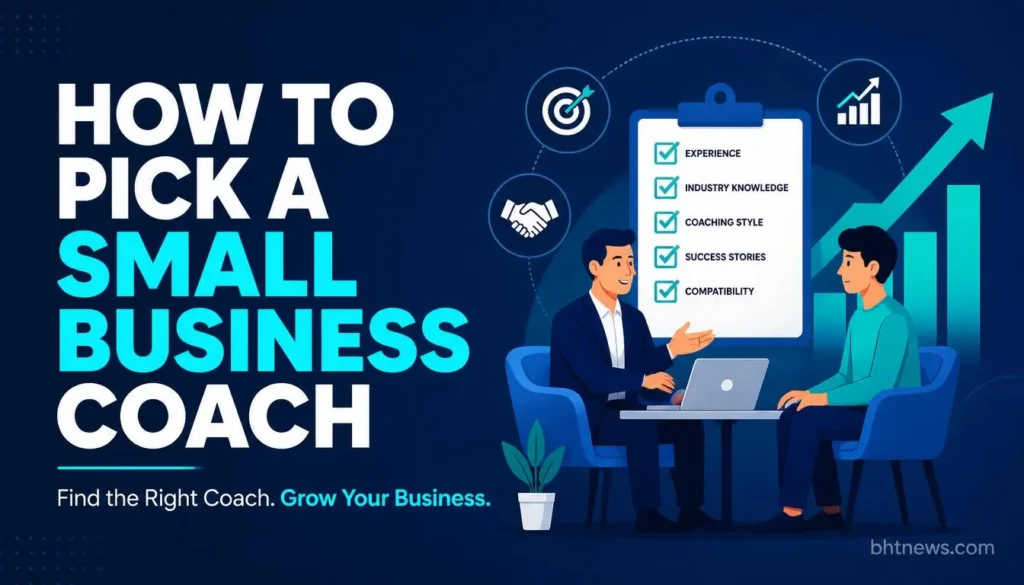
Start by getting ultra clear on your own goals before you jump into coach-hunting. Then, actually interview your top options and check their credentials and references.
The International Coaching Federation (ICF) says you should interview at least three coaches and ask each for at least two references.
- Write down your #1 measurable goal for the next 90 days (for example, “land three paying clients”).
- Choose your budget and format: free mentoring, group program, or 1:1.
- Search a coach directory; ICF has a free searchable one; filter by specialty/experience/location.
- Interview three coaches and ask for two references each.
- Dig into what they’ve actually done: businesses started, or clients like you, not just huge follower counts.
- Get price, refund policy, and deliverables in writing before paying.
On certification, ICF’s 2022 Global Consumer Awareness Study found that 55% of respondents whose coach held a credential were very satisfied, compared with 27% whose coach did not.
ICF issues credentials and has an interest in promoting them, so treat the figure as one data point. Many strong business coaches have no credential but real operating experience. Many top business coaches have no credentials but strong operating experience. Ask about both.
Just Starting? Free Mentors Usually Make More Sense
If you’re a woman launching a business, coaching is most helpful when you’ve got an idea and you’re stuck making real decisions, not just seeking inspiration.
If you’re at the beginning, free options (SCORE, Women’s Business Center, SBDC) cover the basics: planning, costs, pricing, legal stuff.
- Before hiring: Validate your idea with a few potential customers and write out a basic budget. A coach’s time is expensive, so do not spend it on questions a free mentor can answer, so don’t spend it on stuff a free mentor can cover.
- Coach, mentor, or consultant? A coach asks questions and holds you accountable. A mentor shares wisdom. A consultant does or designs the work. Know what you’re paying for.
- When to wait: If you can’t say who your customer is or what you’re selling, stick to free mentoring or a course before splurging on a coach.
What Does a Coach Cost and What Are the Red Flags?
Disclosure: This article is general info, not financial or business advice. Prices, details, and program claims change all the time. And provider numbers/testimonials aren’t guaranteed or typical.
Coaching prices are all over the place, and most aren’t even public. From what I found: SCORE and the Female Entrepreneur Association waitlist are free; SBA calls Women’s Business Centers free, to low-cost; Maya Elious lists $97 per semester for her group program and $5,000 for 90 days of 1:1 coaching. The other providers did not show prices on the pages we read.
The FTC warns about “money-making” offers that tout exaggerated or outright fake income claims; watch for things like:
- Income promises that sound unrealistic or guarantee success with no experience or suggest you’ll succeed with zero experience.
- Pressure to decide before a deadline or sign up before some deadline.
- Claims it’s risk-free or guarantees you’ll get rich.
- Discouraging you from checking references or comparing options.
The FTC says look up how a company works and check their terms yourself. Report income scams.
Questions to Ask Before Paying a Coach
- What actual results have clients like me gotten, and can I talk to two of them?
- What’s the total price, payment plan, term, and refund policy? Can I get it in writing?
- What happens during a typical session, and how much access do I get between sessions?
- What business experience and training qualify you? Are you an ICF-credentialed coach?
- What do you need from me for this to actually work, and when would you say it’s not working?
- Are the results or income numbers on your site typical, and how did you measure them?
Conclusion
Picking a small business coach for women works best when you match the type of support to your stage and budget and stay cautious about pricing claims and ‘best coach’ rankings.
Start with free options, pay only when you have a real goal, and always get the scope and price in writing.
Just remember this is general info, not financial advice. Every coach, program, and price changes, so check the latest details yourself before jumping in.
Frequently Asked Questions
Is there a free business coach for women?
Yes, the free mentors and counselors at SCORE, Women’s Business Centers, and sometimes SBDCs fit the bill. They’re more mentors or counselors than “coaches” like the pricey ones.
Do I need a coach, or will a mentor do?
Early on, a free mentor often does the trick. Paid coaching makes more sense when you’ve got a clear goal and some real commitment, or if you need a skill or accountability gap filled.
How much does a business coach for women cost?
Prices are all over the place, and most coaches don’t post theirs. I found group classes for $97 per semester and private coaching for $5,000 for 90 days; lots of free options too. Get the price and terms in writing.
Are coaching credentials required?
No. In most places, coaching is not a licensed profession, so check the rules where you live. ICF offers credentials and a directory; ask for references either way. ICF offers credentials and a searchable directory; they say clients are happier with credentialed coaches, but always ask for references.
What’s the difference between coach, mentor, and consultant?
A coach helps you answer your own questions and stick to your goals. A mentor shares their personal experience. A consultant does or designs solutions for you. You might need all three at different times.
Can a coach guarantee you’ll make more money?
A trustworthy coach should not promise income. The FTC lists guaranteed-income claims as a scam warning. FTC says “guaranteed income” is a scam warning. Look for coaches who say up front they can’t guarantee results.
How do I know if a coach is right for me?
Interview at least three, talk to references, and check their experience against your stage. Free intro sessions, like Rosetta Thurman’s, are a low-risk way to test fit.